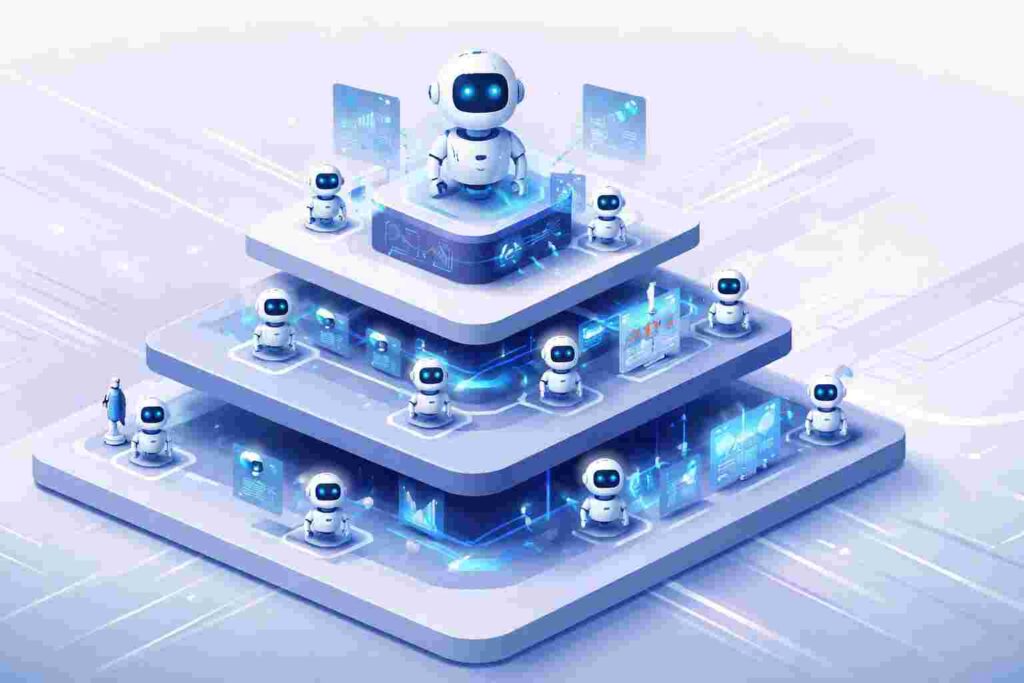
In the landscape of artificial intelligence, hierarchical agent architectures stand out as a pivotal concept, shaping how intelligent systems are designed and implemented. These architectures are not just a technical evolution; they represent a fundamental shift in the way AI can be segmented into manageable, efficient departments, much like a well-organized corporation. This article will delve into the complexities of hierarchical agent architectures, elucidate their significance in modern AI, and explore their broad impacts across various industries, including healthcare, finance, and manufacturing. By understanding the foundations, technical mechanisms, business implications, and future outlook of these architectures, we can appreciate their transformative potential. Let’s embark on a journey to discover what makes hierarchical agent architectures vital in today’s technological era.
Understanding Hierarchical Agent Architectures
To comprehend the essence of hierarchical agent architectures, we need to break down their core characteristics, historical context, and the key components that define their operation.
Definition and Key Characteristics
- A hierarchical agent architecture is a structured framework where multiple agents operate at different levels.
- These agents can process tasks independently and collaboratively, improving efficiency and precision.
- Typically, each agent possesses its specific function, making the system more adaptable and scalable.
- Such architectures allow for the separation of complex tasks into simpler, manageable components, enhancing system clarity and focus.
Historical Context
The evolution of hierarchical architectures in AI can be traced back to early models of organizational structuring in complex systems. Originally introduced in the context of robotics, hierarchical approaches gained traction as they demonstrated significant efficiencies in task management. The progression from flat structures to layered architectures illustrated a critical shift in understanding how tasks can be compartmentalized and managed, paving the way for more sophisticated AI systems.
Key Components and Workings
- Agents: Autonomous entities that can perceive, act, and make decisions.
- Communication Layer: Facilitates interaction between agents, allowing for coherent task execution.
- Control Structures: Define how agents are coordinated and how tasks are delegated based on priorities.
- Environment: The objective reality where agents operate, influencing their behavior and decision-making processes.
Technical Mechanisms Behind Multi-Level Agents
Understanding how hierarchical agent architectures function requires a dive into their technical underpinnings, including common frameworks, algorithmic approaches, and potential integration challenges.
Common Frameworks and Tools
- Robot Operating System (ROS): Provides services designed for a heterogeneous computer cluster of multiple agents.
- JADE (Java Agent DEvelopment Framework): A popular platform for developing multi-agent applications.
- OpenAI Gym: Offers a toolkit for developing and comparing reinforcement learning agents in a simulation environment.
- AgentSpeak: A programming language specifically designed for agent-oriented programming.
Algorithmic Approaches
Hierarchical architectures often utilize various algorithmic models to enhance agent decision-making capabilities. Techniques such as reinforcement learning enable agents to adapt based on feedback from their environment, while layered decision systems help in managing complex deliberation processes across different levels. This results in a system capable of both high-level strategy formulation and low-level tactical execution.
Integration Challenges
- Inter-Agent Communication: Establishing clear communication channels is vital for the functioning of multi-level agents.
- Data Synchronization: Keeping all agents aligned with up-to-date information can be challenging.
- Compatibility Issues: Different agents might use varying protocols and formats, leading to potential friction.
- Scalability Concerns: As more agents are added, ensuring the system remains efficient can be difficult.
Business Impacts Across Industries
The infusion of hierarchical agent architectures in various sectors has revolutionized operations, leading to impactful changes and significant returns on investment (ROI).
Healthcare Innovations
- Efficient patient data management through specialized agents.
- Improved diagnostics accuracy via data analysis agents.
- Autonomous robots for surgical assistance, minimizing human error.
- Predictive models that improve patient care and reduce costs.
Automotive Developments
The automotive industry particularly benefits from hierarchical agent architectures. For example, in autonomous vehicles, different agents are responsible for navigation, obstacle detection, and decision-making processes. This division of labor aids in navigating complex environments safely and efficiently. Companies like Tesla and Waymo have successfully implemented such architectures, enhancing vehicle capabilities and safety measures.
Finance and Risk Management
- High-frequency trading using algorithms tuned for speed and accuracy.
- Risk assessment agents analyzing diverse data patterns.
- Fraud detection systems that monitor transactions in real-time.
- Investment strategies adaptive to market shifts.
Manufacturing Efficiency
Hierarchical structures have enabled smart manufacturing, where machines communicate and coordinate tasks among themselves. This significantly reduces production bottlenecks, lowers operational costs, and improves overall throughput.
Retail Enhancements
- Automated inventory management systems that react to stock levels in real-time.
- Customer service agents that understand and respond to consumer inquiries effectively.
- Sales prediction agents optimizing stock based on trend analysis.
- Personalized marketing strategies created through data analysis agents.
Strategic Advantages of Using Hierarchical Structures
While the implementation of hierarchical agent architectures offers numerous benefits, there are also strategic advantages that stand out in various business contexts.
Enhanced Decision-Making Processes
- Better data analysis capabilities lead to increased accuracy in decision-making.
- Reducing cognitive overload by distributing tasks among agents.
- Improved responsiveness to changes in the market or environment.
- Dynamic adjustment to unforeseen challenges through rapid internal communication.
Improved Scalability
Hierarchical agent designs are inherently scalable. Companies can integrate additional agents to handle increased loads without a complete system overhaul. This modular approach is vital for rapidly evolving industries where demands can fluctuate significantly.
Cognitive Load Reduction
- Pragmatic task alignment helps lower the mental burden on human operators.
- Simplification of complex systems through layer-specific tasks.
- Reduction in training time for users adapting to the system.
- Enhancement of user experience through guided interactions.
Resource Optimization
Efficient use of resources is achieved through task delegation among agents, ensuring that energy and time are not squandered on redundant processes. For example, in a smart factory setting, energy usage can be optimized based on varying workloads, leading to significant cost reductions.
Limitations and Risks of Hierarchical Architectures
Despite the many advantages, hierarchical agent architectures are not without their challenges. It is essential to recognize the limitations and risks involved in their implementation.
Complexity of Management
- The intricacy of managing multiple agents increases the overhead costs.
- Higher chances of miscommunication if not adequately monitored.
- Need for specialized skills to manage these systems effectively.
- Challenges in troubleshooting due to interdependent tasks among agents.
Dependence on Quality Data
Hierarchical agents heavily rely on the integrity of the data they process. Poor data quality can lead to incorrect decision-making and can significantly undermine the effectiveness of the system. Businesses need to establish robust data governance frameworks to mitigate these risks.
Reliability and Trustworthiness Issues
- Agents must be designed to ensure they perform optimally without human intervention.
- Trust must be established through consistent performance and reliability.
- Potential for system failure if agents malfunction or encounter unexpected scenarios.
- Need for fallback protocols to handle failures gracefully.
Evaluation of Hierarchical Architectures vs. Flat Structures
To fully understand the strengths of hierarchical architectures, we can compare their effectiveness against traditional flat structures. The following table illustrates this comparison across several critical factors.
| Factor | Hierarchical Structures | Flat Structures |
|---|---|---|
| Performance Metrics | High operational efficiency with multi-agent collaboration | Potential lower efficiency with overlapping responsibilities |
| Scalability | Easily scalable with minimal disruption | More challenging to scale effectively without restructuring |
| Decision-Making Speed | Can enhance speed with parallel processing | May experience delays due to centralized decision-making |
Statistics and Market Trends in Agent Architecture Adoption
The adoption of hierarchical agent architectures across industries is on the rise. According to industry reports, the market for AI-enabled systems is expected to reach $190 billion by 2024, reflecting a CAGR of around 42%. These statistics underscore the increasing investments companies are making to integrate advanced AI solutions into their operations.
Growth Rates in Key Industries
- Healthcare AI market projected to grow at a CAGR of 49.5% until 2026.
- The automotive sector is investing heavily in AI-driven safety features.
- Finance sector adoption of AI solutions growing by 35% annually.
- Manufacturing AI-driven automation systems expanding at a rapid pace.
Investment Trends
As industries begin to recognize the potential of hierarchical agent architectures, investments are pouring into technology startups focusing on AI. Notably, funding for AI applications surged to over $33 billion in 2021 alone, reflecting a growing confidence in the transformative power of these technologies.
User Adoption Statistics
- Around 60% of companies are piloting AI projects.
- Over 30% of businesses reported deploying AI solutions across multiple operational areas.
- 75% of executives view AI as a strategic priority for the next 5 years.
- More than 50% of companies expect to scale their AI initiatives significantly by 2025.
Real-World Case Studies of Hierarchical Agent Implementations
Examining real-world applications of hierarchical agent architectures can offer invaluable insights into their practical benefits and measurable outcomes.
Case Study 1: Healthcare System Overhaul
In a hospital in New York City, the integration of hierarchical agent architectures into their patient management system led to 20% faster patient processing times and a 30% reduction in errors during data handling. These metrics underscore the effectiveness of specialized agents managing various facets of patient care, from scheduling to billing.
Case Study 2: Autonomous Vehicle Development
Waymo’s autonomous driving technology operates through a layered architecture where each agent is optimized for specific driving conditions. Following the implementation, the number of successful autonomous journeys increased by over 40%, showcasing reduced human oversight and enhanced operational safety.
Case Study 3: Supply Chain Optimization
A logistics company employed hierarchical agent structures to manage its distribution network. By implementing specialized agents for real-time inventory tracking and demand forecasting, the company reported a 25% decrease in delivery times while simultaneously cutting costs by 15%.
Future Outlook for Hierarchical Agent Architectures
The future for hierarchical agent architectures appears promising as emerging technologies and industry adaptations take shape.
Emerging Technologies
- The integration of quantum computing could revolutionize agent processing capabilities.
- Advancements in natural language processing will allow agents to interact more intuitively.
- Edge computing will enable decentralized processing for improved response times.
- Improved sensor technologies will enhance the perception capabilities of physical agents.
Predicted Industry Adaptations
Industries are expected to continue adapting hierarchical structures for greater efficiency and effectiveness. In sectors like healthcare and finance, AI-driven solutions will increasingly dominate, leading to streamlined operations and better customer experiences.
Long-term Implications for AI Development
- As hierarchical architectures become standard, AI capabilities will evolve significantly.
- Adaptive systems will emerge that can self-optimize based on learning.
- Ethical considerations will become paramount as decision-making processes are delegated to machines.
- Long-term collaboration between humans and AI will progress as trust in these systems grows.
Frequently Asked Questions about Hierarchical Agent Architectures
What are the main components of hierarchical agent architectures?
Hierarchical agent architectures consist of several key components including agents themselves, which act autonomously, a communication layer that facilitates interaction among them, and control structures that govern tasks. Each component plays a crucial role in ensuring that the system operates smoothly, allowing agents to perform their designated roles effectively. Management of these elements can significantly influence the overall efficiency and reliability of the hierarchical system.
How do hierarchical agents differ from traditional AI?
Unlike traditional AI systems, which often operate as monolithic structures with centralized decision-making, hierarchical agents function through decentralized, multi-level decision-making. This allows for enhanced scalability, adaptability, and specialization in performing various tasks. Hierarchical structures can more efficiently handle complex tasks by breaking them down and leveraging the strengths of individual agents.
Are there industries that particularly benefit from these architectures?
Yes, certain industries gain more from hierarchical agent architectures, particularly those involving complex, dynamic processes. Healthcare, automotive, finance, and manufacturing sectors have all seen transformative impacts through the implementation of these architectures. Each industry leverages the architecture differently but can attain substantial efficiency gains and improved decision-making capabilities.
What are the common implementation challenges?
Common challenges in implementing hierarchical architectures include ensuring effective inter-agent communication, maintaining data synchronization, and addressing compatibility issues among diverse agents. Additionally, managing the complexity of multiple agents and ensuring their collaborative efficiency can pose significant obstacles. Effectively tackling these challenges often requires dedicated resources and a well-defined strategy for implementation.
How does one measure the success of a hierarchical agent system?
Success can be gauged through various metrics such as operational efficiency, error rates, and improvement in response times. Significant changes in productivity or cost reduction can signal effective implementation. Additionally, user feedback can provide qualitative insights into the system’s performance, informing further optimizations or adjustments as required.
What is the future of hierarchical architectures in AI?
The future of hierarchical architectures in AI is bright and filled with potential advancements in technology fostering increased efficiency and adaptability. As industries keep evolving and integrating AI at a broader scale, hierarchical agent structures are likely to become foundational, enabling sophisticated interactions and collaborative functionalities between agents. Growth in ethical AI considerations will also drive development, ensuring these systems align with societal values and expectations.
Conclusion: The Path Ahead for Hierarchical Agent Architectures
In summary, hierarchical agent architectures represent a crucial advancement in the field of artificial intelligence. They offer enhanced scalability, decision-making efficiency, and operational effectiveness that can benefit a diverse range of industries. As businesses continue to embrace these technologies, the expectation is set for accelerating innovation and societal improvement. Looking ahead, it may be vital for organizations to explore the vast opportunities that hierarchical architectures present, securing their footing in an increasingly AI-driven future.
- Recap of Key Benefits: Enhanced operational efficiency, improved decision-making, and team adaptability.
- Final Thoughts on Industry Trends: Continued investment and interest in AI solutions will cultivate innovation.
- Encouragement for Further Exploration: Organizations should actively seek to integrate hierarchical agent architectures into their strategies for competitive advantage.