
Introduction
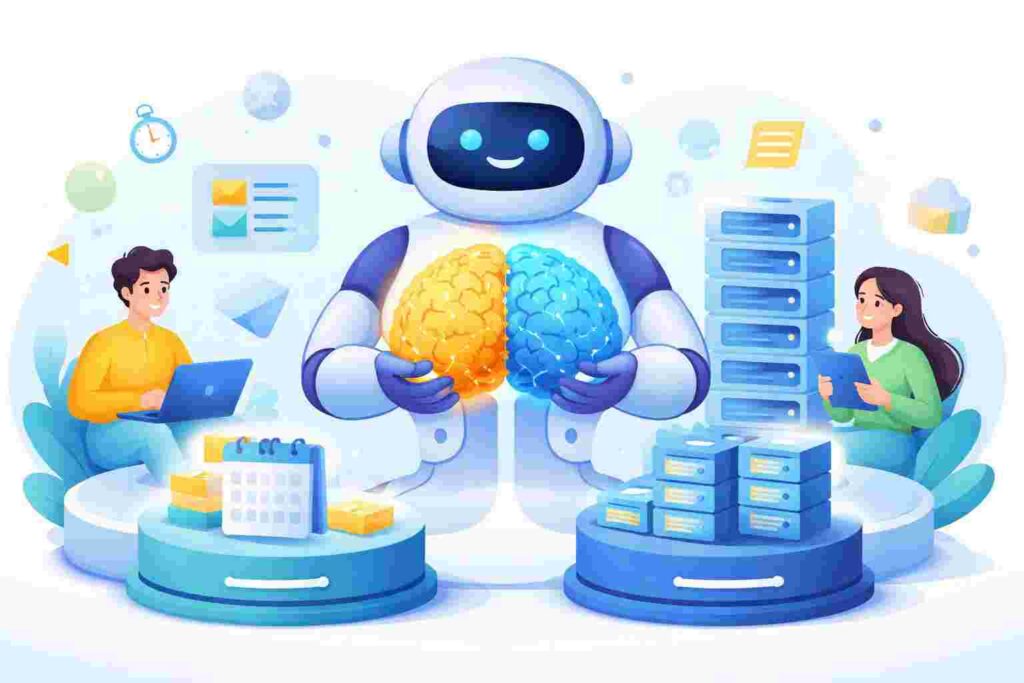
In the realm of artificial intelligence, the concepts of short-term and long-term memory play pivotal roles in shaping the cognition and performance of agents. Understanding these memory types is essential, as they fundamentally influence how agents process information, learn from experiences, and make decisions. This article delves into the intricacies of memory in agents, shedding light on foundational theories, mechanisms of memory retrieval and storage, the impacts on various industries, strategic advantages, and limitations associated with these systems.
Understanding Memory Types in Agents
A clear grasp of short-term and long-term memory is crucial for developing intelligent agents. Each type serves specific purposes and functions in the processing of data and interactions with the environment.
Definition of Short-Term Memory in Agents
Short-term memory (STM) in agents refers to the immediate, temporary storage of information that is actively used in ongoing tasks. This memory type is characterized by its limited capacity and duration, allowing agents to hold information for a brief period while performing computations or actions. For instance, when an AI chatbot engages in a conversation, it relies heavily on its short-term memory to remember the context and nuances of the interaction.
Definition of Long-Term Memory in Agents
Long-term memory (LTM), on the other hand, refers to the persistent storage of information over extended periods. This memory type allows agents to retain knowledge, experiences, and patterns that can be accessed and utilized in future tasks. Long-term memory is essential for learning processes, as it enables the agent to build upon past experiences to improve performance over time, similar to how humans retain knowledge for future use.
Differences between Short-Term and Long-Term Memory
- Duration: Short-term memory holds information for seconds to minutes, while long-term memory can store data for years or indeterminately.
- Capacity: STM has a limited capacity (typically 7±2 items), whereas LTM can store an immense amount of information.
- Functionality: STM is utilized for immediate tasks, while LTM serves as a database of knowledge and learned behaviors.
- Recall: Information in STM is readily accessible, while recalling LTM may require specific cues or triggers.
- Impact on Performance: STM influences real-time responses, whereas LTM affects long-term decision-making and learning.
Mechanisms of Memory Retrieval and Storage
Understanding how agents retrieve and store memories is paramount for enhancing their functionality. This section explores the underlying technical mechanisms that facilitate effective memory utilization.
Memory Encoding Processes
Memory encoding involves transforming information into a format suitable for storage. For agents, this process includes various techniques such as data normalization, feature extraction, and pattern recognition. Effective encoding ensures that relevant data is retained for both STM and LTM applications, ultimately enhancing the agent’s ability to respond accurately to queries and tasks.
Memory Retrieval Techniques
Memory retrieval allows agents to access stored information when needed. Techniques for retrieval can include direct access via indexed databases, cue-based retrieval through context and similarity, and reinforcement learning methods that enhance the likelihood of recalling specific memories based on use frequency. Efficient retrieval mechanisms significantly improve agents’ responsiveness and decision-making capabilities.
Storage Architectures Used in AI
- Neural Networks: Used extensively for both short-term and long-term memory, neural networks learn patterns from data.
- Key-Value Stores: They allow agents to store information in a way that can be quickly retrieved based on unique identifiers.
- Hierarchical Memory Structures: These allow differentiation between various types of memories and facilitate organization.
- Database Systems: Traditional databases can manage long-term memory by tracking extensive datasets with efficient querying capabilities.
- Memory Augmentation Systems: These systems improve STM by employing caching techniques to speed up information access.
Impact of Memory on Agent Performance
Memory systems have profound impacts on the efficiency of AI agents across various industries. This section highlights specific business applications and their corresponding effectiveness.
Memory Capacity in Customer Support AI
AI-driven customer support chatbots use both short-term and long-term memory to enhance user interactions. For instance, short-term memory allows these agents to keep track of ongoing conversations, while long-term memory stores past interactions to provide personalized responses. As a result, businesses have reported up to a 30% increase in customer satisfaction ratings when leveraging well-implemented memory systems.
Optimization in Autonomous Vehicles
In autonomous vehicles, the integration of memory capabilities allows for the storage of navigation routes, traffic patterns, and driver preferences. Short-term memory enables real-time decision-making based on current conditions, while long-term memory contributes to improved route planning over time. The implementation of advanced memory systems has led to a 20% reduction in travel time as vehicles learn from previous experiences.
Smart Assistants: Enhancing User Experience
Smart home assistants, such as Alexa and Google Home, leverage memory to create personalized experiences. By remembering user preferences for music and temperature settings, these assistants can improve user satisfaction significantly. Industry reports show that effective memory utilization may lead to a 25% increase in user engagement.
Strategic Advantages of Memory Implementation
Incorporating effective memory systems offers strategic advantages that can differentiate successful AI agents in competitive markets.
Enhanced Decision-Making Processes
Memory systems allow AI agents to utilize historical data when making decisions. By accessing long-term memory, agents can evaluate previous outcomes and refine their strategies, leading to more informed decisions. Companies leveraging this capability have found that it can yield better outcomes and optimize operations.
Improved Learning Algorithms
Integration of memory into learning algorithms fosters more adaptive and intelligent systems. Agents can learn from past behaviors, mistakes, and successes, resulting in a more streamlined and efficient learning process.
Retention of User Preferences
- Personalization: Tailoring experiences based on recalled preferences enhances user satisfaction.
- Relevancy: Memory systems help maintain contextually relevant interactions.
- User Trust: Consistent memory leads to increased trust from users towards the agent.
- Efficiency: Reduces the need for repeated inputs from users, improving overall efficiency.
- Engagement: Personalized interactions keep users engaged longer.
Limitations and Risks of Memory Systems
While memory systems confer significant advantages, they also present potential limitations and risks that must be carefully managed.
Overfitting in Learning Algorithms
Overfitting occurs when a learning algorithm becomes too tailored to its training data, leading to poor performance on new, unseen data. This risk is particularly pertinent in memory systems, where excessive reliance on previous experiences may hinder the agent’s adaptability to changing circumstances.
Data Privacy Concerns
Memory systems in AI often require the storage of personal data, raising significant privacy concerns. Users may feel uncomfortable with how their information is used, leading to distrust. Companies must ensure they implement strong data protection methods and adhere to regulations to mitigate these risks.
Potential for Memory Decay
- Information Loss: Over time, less frequently accessed memories may become less retrievable.
- Relevancy Decline: As context changes, older memories may become irrelevant, impacting performance.
- Maintenance Requirements: Ongoing optimization is necessary to keep memory systems effective.
- Resource Intensive: Memory management can require significant computational resources.
- User Perception: If memory systems fail or decay, users may become dissatisfied.
Comparative Analysis of Memory Models
This section evaluates various memory models used in AI, providing insights into their effectiveness and suitability for different applications. Below is a comparative table showcasing key features of short-term and long-term memory models.
| Feature | Short-Term Memory Model | Long-Term Memory Model |
|---|---|---|
| Storage Duration | Seconds to Minutes | Years to Indefinitely |
| Capacity | Limited (7±2 items) | Vast and Expanding |
| Application | Real-time Tasks | Knowledge Retention |
| Access Speed | Immediate | Variable (Depends on Cues) |
| Learning Ability | Low | High |
Model Performance Evaluation Criteria
- Predictive Accuracy: Assessing how well a model predicts outcomes based on historical data.
- Adaptability: Evaluating how well a model can respond to new information without prior exposure.
- Efficiency: Measuring the computational resources required to retrieve and utilize memory.
- Robustness: How well a model performs under varying conditions.
- Simplicity: Ease of implementation and understanding.
Best Practices in Model Selection
Choosing the appropriate memory model entails understanding the specific needs of the application. Factors to consider include the need for immediate access versus long-term knowledge retention, computational resources available, and the context in which the agent operates. Employing hybrid models that combine features of both STM and LTM may yield optimal performance.
Current Statistics and Market Trends
The market for memory-enabled AI is rapidly evolving. Here we present some current statistics and trends impacting this sector.
Market Growth Rate for Memory-Enabled AI
Recent reports indicate that the global market for AI memory technology is expected to grow at a compound annual growth rate (CAGR) of 25% over the next five years, with significant investments pouring into memory-enhanced systems.
User Adoption Statistics
Surveys show that approximately 62% of businesses are adopting AI systems with advanced memory capabilities, highlighting a shift toward personalized and data-driven user experiences. Employers increasingly recognize the value that memory systems provide in improving operational efficiency and customer satisfaction.
Investment Trends in Memory Technologies
- Funding Increases: Venture capital investments in memory technology firms have surged by 40% in the past year.
- Emerging Startups: New startups focusing on memory systems for AI are emerging, focusing on innovative solutions.
- Corporate Collaborations: Established tech companies are forming partnerships to enhance memory capabilities in their products.
- Market Expansion: The memory technology market is predicted to exceed $10 billion by 2028, driven by demand in various sectors.
- Research Initiatives: An increase in federal funding for research on AI memory systems is anticipated.
Real-World Case Studies of Memory Applications
The following case studies illustrate how memory systems can dramatically improve outcomes for users and businesses alike.
Case Study: AI in Healthcare Diagnostics
In a healthcare setting, an AI system was implemented to analyze patient data for diagnostic purposes. Before implementation, the diagnostic accuracy was around 70%. After integrating both STM for real-time data analysis and LTM for historical data, the accuracy improved to over 85%. This significant enhancement in decision-making supports more accurate and timely patient care.
Case Study: Memory in E-Commerce Personalization
An e-commerce platform employed AI with advanced memory capabilities to personalize user experiences based on past interactions. Previously, their conversion rate hovered around 2%. With effective memory systems, they saw the conversion rate elevate to approximately 5%, demonstrating a clear ROI from enhanced user engagement.
Case Study: Chatbot Efficiency Improvements
A customer service chatbot incorporated memory systems to recall previous interactions with customers. Initially, the bot resolved 60% of inquiries successfully. Following the update, the resolution rate increased to 80%, highlighting the transformative impact of memory systems on operational efficiency and user satisfaction.
Future Outlook for Memory in AI Agents
As technology continues to evolve, the future of memory in AI agents holds exciting possibilities.
Emerging Technologies in Memory Systems
Advancements like quantum computing and neuromorphic computing are projected to revolutionize memory systems. These technologies promise to enhance processing speed and memory efficiency, enabling agents to perform complex tasks more intelligently.
Predicted Advancements in Learning
Future AI systems may utilize advanced reinforcement learning techniques to optimize memory retrieval and storage, further enhancing learning capabilities. This evolution could lead to more autonomous and smart agents capable of adapting to diverse environments with minimal human intervention.
Potential Ethical Considerations
- Data Ownership: Who owns the information stored within AI memory systems?
- Transparency: Users must understand how their data is used and stored.
- Accountability: Establishing accountability for decisions made by memory-enabled AI.
- Informed Consent: Users should consent to data collection and memory utilization.
- Bias Mitigation: Ensuring memory systems do not perpetuate biases from training data.
FAQs on Short-Term and Long-Term Memory in Agents
What is the difference between short-term and long-term memory in AI?
Short-term memory (STM) in AI agents is designed for immediate tasks, allowing agents to hold information temporarily for tasks such as conversations or real-time computations. Conversely, long-term memory (LTM) is meant to retain information over extended periods, enabling the agent to recall past experiences to inform future actions. Essentially, STM is for current interactions, while LTM is for accumulated knowledge.
How do agents utilize memory in practical applications?
Memory in AI agents serves several practical applications across various fields. In customer support, agents use memory to track ongoing conversations, maintaining context for better service. In healthcare, memory helps agents analyze past patient data for diagnostics. Ultimately, memory enables agents to respond to inquiries more efficiently and accurately, improving satisfaction and outcomes.
Can short-term memory impact long-term learning?
Yes, short-term memory can significantly impact long-term learning. By retaining immediate inputs temporarily, an agent can analyze information actively, leading to better encoding into long-term memory. Efficient use of STM can enhance the learning experience by allowing agents to promptly respond to new inputs and adjust behaviors based on recently learned information.
What are some examples of memory in AI systems?
Examples of memory utilization in AI systems include chatbots shopping assistants that remember past interactions to personalize recommendations. Autonomous vehicles use memory to store navigation preferences, while smart assistants track user preferences for music and resumes. Each of these applications demonstrates how memory improves user experience and operational efficiency.
How do memory systems evolve over time?
Memory systems in AI evolve through continuous learning from interactions and experiences. Agents can refine their memory architectures by optimizing retrieval processes, adjusting storage techniques, and learning to disregard irrelevant data. This evolutionary process is vital for agents to adapt effectively to changing contexts and user preferences.
What are the ethical implications of memory in agents?
Memory systems in AI raise ethical concerns primarily related to data privacy, ownership, and consent. It is pivotal to ensure that users are informed about how their data is collected and utilized in memory systems. Additionally, accountability for decisions made by AI based on memory is an important consideration to prevent biases and promote fairness in AI applications.
Conclusion
In conclusion, a comprehensive understanding of short-term and long-term memory in agents is essential for harnessing their capabilities effectively. As memory systems continue to develop, their implications for AI cognition and performance will shape the landscape of artificial intelligence. Organizations that strategically implement these memory systems are likely to gain significant competitive advantages, fostering better decision-making processes, enhanced user experiences, and optimized operational efficiencies in various industries.