In the rapidly evolving tech landscape, Agentic AI is emerging as a groundbreaking concept that raises fundamental questions about the nature of intelligence and decision-making. As organizations increasingly look to integrate AI solutions, understanding the nuances of Agentic-AI can illuminate its transformative potential across multiple sectors. This article delves deep into the foundational concepts, technical mechanisms, business implications, and future outlook of Agentic AI, providing a comprehensive roadmap for stakeholders at all levels.
Table of Contents
Foundational Concepts of Agentic-AI
To grasp the significance of Agentic-AI, we must first define it and explore its key principles. At its core, Agentic AI refers to systems capable of making autonomous decisions based on their understanding of an environment. This capability sets it apart from traditional AI systems, which typically require extensive human intervention.
Definition and Origins
The term ‘Agentic AI’ originates from the intersection of artificial intelligence and agency, highlighting machines’ ability to act independently of direct human control. The concept can be traced back to theoretical discussions around machine learning and autonomy that have been evolving over the past few decades. As AI research progresses, the notion of agency becomes ever more relevant, enabling machines to perform tasks that were once solely within the human domain.
Human vs. Machine Agency
A critical distinction exists between human and machine agency. Human agency is characterized by conscious decision-making influenced by emotions, experiences, and social contexts, whereas machine agency is primarily driven by data patterns and algorithms. Recognizing this difference is vital for understanding the scope and limitations of Agentic AI. While machines can execute tasks and make decisions based on predefined parameters, their lack of true consciousness poses unique challenges.
Key Characteristics
- Autonomy: The ability to act independently without human input.
- Adaptivity: The capacity to adjust actions based on environmental feedback.
- Learning Capability: Utilizing machine learning to improve performance over time.
- Context Awareness: Understanding situational contexts to inform decision-making.
- Interactivity: The capability to engage with humans and other systems effectively.
The Technical Mechanisms Behind Agentic-AI
Understanding the technical foundation of Agentic AI is essential to appreciate its functionalities fully. The industry employs several advanced methodologies to facilitate autonomous decision-making processes.
Machine Learning Algorithms
At the heart of Agentic AI lies machine learning, particularly deep learning algorithms that enable systems to process vast amounts of data. These algorithms utilize neural networks to recognize patterns and learn from them, constantly refining their operations. Approaches such as supervised learning, unsupervised learning, and reinforcement learning are pivotal in training Agentic AI models to make informed choices.
Decision-Making Processes
Agentic AI systems employ sophisticated decision-making frameworks based on real-time data processing. They utilize heuristics—rules of thumb derived from data analysis—enabling them to make efficient decisions under uncertainty. A notable example is the use of Bayesian networks, which allows these systems to incorporate prior knowledge into their evaluations, thus enhancing the decision-making process.
Natural Language Processing in Agentic-AI
Natural Language Processing (NLP) is integral to enabling Agentic AI to communicate and interpret human language effectively. Through advanced NLP techniques, these systems can analyze text, extract meaning, and generate coherent responses. Recent advancements like transformers and large language models have significantly enhanced the capability of Agentic-AI to engage in human-like interactions, making it more relatable in various applications.
Business Impact of Agentic-AI
The proliferation of Agentic AI is reshaping industries by increasing operational efficiency, transforming customer interactions, and optimizing resource allocation. Understanding its impact across various sectors highlights the strategic advantages organizations can gain.
Healthcare Transformation
Agentic AI is revolutionizing healthcare by improving patient outcomes through predictive analytics and personalized treatment plans. For instance, AI-driven diagnostic tools can analyze medical images with high accuracy, assisting healthcare professionals in identifying conditions earlier. A study revealed that AI models could diagnose certain diseases up to 94% of the time, compared to 80% for human practitioners.
Finance and Investment Strategies
In the finance sector, Agentic AI enhances investment decision-making by analyzing market trends and predicting stock movements. AI algorithms process vast datasets at speeds unattainable by humans, allowing for more informed trading decisions. Financial institutions leverage Agentic-AI for algorithmic trading, risk assessment, and fraud detection, significantly reducing operational costs and improving ROI.
Manufacturing Efficiency
Manufacturing firms are increasingly adopting Agentic AI to enable predictive maintenance of equipment and optimize production processes. By analyzing sensor data from machinery, AI systems can forecast failures before they occur, significantly lowering downtime costs. Companies integrating Agentic-AI into their production lines have reported efficiency improvements of up to 30%.
Retail Customer Engagement
In retail, Agentic AI enhances customer experiences through personalized recommendations and chatbots capable of handling customer inquiries. By analyzing shopping behavior and preferences, retailers can tailor marketing strategies, leading to increased sales. Reports indicate that retailers utilizing AI for customer engagement see up to a 15% increase in conversions.
Strategic Advantages of Implementing Agentic-AI
Organizations investing in Agentic AI technology stand to gain several strategic advantages, from enhanced decision-making capabilities to improved customer insights.
Enhanced Decision-Making
By automating data analysis and decision-making processes, Agentic AI enables organizations to make decisions faster and more accurately. The ability to analyze vast datasets without human biases plays a crucial role in maintaining objectivity, fostering better business outcomes.
Increased Operational Efficiency
- Reduction of manual errors through automation.
- Faster processing and analysis of information.
- Improved resource allocation based on data insights.
- Lower operational costs through enhanced productivity.
- Scalability across various business functions.
Better Customer Insights
With the capability to analyze customer behavior patterns, Agentic AI helps organizations understand their target audiences better. This leads to more tailored products and services, directly impacting customer satisfaction and loyalty.
Limitations and Risk Considerations with Agentic-AI
While Agentic AI offers remarkable advantages, it also poses several risks and limitations that organizations must navigate. Understanding these challenges is essential for responsible implementation.
Ethical Implications
The deployment of Agentic AI raises significant ethical concerns, particularly regarding accountability. When machines make independent decisions, questions arise about who is responsible for errors or malicious outcomes. Establishing clear guidelines and ethical frameworks is crucial for mitigating these risks.
Bias and Fairness Issues
Agentic AI systems can inadvertently perpetuate biases present in the training data. Addressing these issues requires a robust approach to data curation and algorithmic transparency. Organizations must actively work to ensure that their AI systems deliver fair and equitable outcomes.
Dependence on Technology
Organizations may become overly reliant on Agentic AI, leading to potential vulnerabilities if the technology fails or is compromised. A comprehensive risk management strategy is necessary to balance autonomy with human oversight, ensuring that critical decisions are not exclusively relegated to machines.
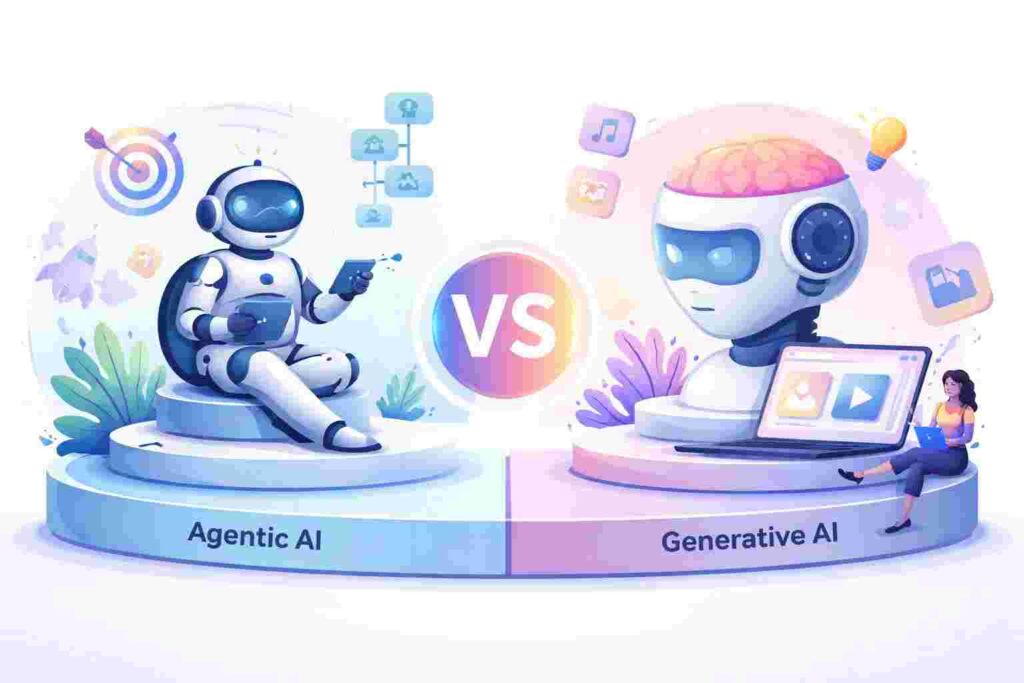
Comparison of Agentic-AI with Traditional AI Models
A comparison of Agentic AI with traditional AI models showcases the evolution of technology and its applications.
| Feature | Agentic AI | Traditional AI |
|---|---|---|
| Autonomy | High | Low (Requires human intervention) |
| Learning Capability | Self-learning from data | Dependent on pre-programmed algorithms |
| Decision-Making | Real-time, environment-aware | Static, rule-based decisions |
| Adaptivity | Highly adaptive | Limited adaptability |
| Data Utilization | Utilizes extensive datasets | Limited to available datasets |
Statistics and Market Trends in Agentic-AI
The market for Agentic AI is rapidly expanding. According to recent reports, the global Agentic AI market is projected to grow from $5.75 billion in 2023 to $35.9 billion by 2030, reflecting a CAGR of approximately 32% over the next seven years. The increasing adoption of AI strategies across sectors is driving this growth.
Adoption Rates by Industry
- Healthcare: 65% of organizations have begun integrating AI solutions.
- Finance: 58% report active AI deployment for trading operations.
- Manufacturing: 50% of companies are utilizing AI for predictive maintenance.
- Retail: 70% are exploring AI for enhanced customer experience.
- Logistics: 48% are investing in AI for route optimization.
Predictions for Future Growth
As we look to the future, estimates indicate that companies incorporating Agentic AI into their operations will achieve productivity gains of up to 40% by 2025. Furthermore, the demand for skilled professionals in the Agentic-AI field is likely to surge, with a projected increase of 20% in job openings annually. These trends suggest that organizations prioritizing Agentic-AI will have a competitive advantage in the coming years.
Real-World Case Studies of Agentic-AI Implementation
Examining real-world case studies provides valuable insights into the tangible benefits of Agentic AI technology.
Case Study: Healthcare Provider Outcomes
A well-known healthcare provider implemented an AI diagnostic tool that utilizes Agentic AI principles. Before its deployment, diagnostic accuracy was approximately 80%. Post-implementation, accuracy improved to 95%, significantly reducing misdiagnoses and enhancing patient care. This substantial uptick not only improved patient outcomes but also reduced operational costs related to misdiagnosis.
Case Study: Financial Institution Success
A leading financial institution adopted Agentic AI for fraud detection, shifting from a reactive to a proactive approach. Initially, fraud identification took several hours, but with the deployment of AI technology, detection times decreased to a mere few seconds. The institution reported a 40% reduction in fraud cases, directly correlating to their investment in Agentic-AI.
Comparative Benefits Before and After Implementation
- Healthcare: Before – 80% diagnostic accuracy, After – 95%.
- Finance: Before – hours for fraud detection, After – seconds.
- Manufacturing: Before – 20% downtime, After – reduced to 5%.
- Retail: Before – standard marketing strategies, After – personalized targeting leading to 15% increase.
- Logistics: Before – 10% delivery delays, After – reduced to 2%.
Future Outlook for Agentic-AI
The future of Agentic AI hinges on continued innovation and integration into various sectors. As we project into the coming years, numerous trends and advancements are anticipated.
Emerging Technologies and Innovations
Innovations in quantum computing and edge AI are expected to contribute significantly to the advancement of Agentic AI. These technologies will allow AI systems to process information more rapidly, ultimately enhancing their decision-making capabilities.
Predicted Industry Transformations
Foremost industries will likely see unprecedented transformations. For instance, by 2030, we could witness smart cities utilizing Agentic AI for traffic management, reducing congestion by as much as 30%. In healthcare, AI-driven preventive care measures could lead to a notable decrease in hospitalization rates.
Future Challenges and Opportunities
Despite its potential, challenges such as data privacy, ethical dilemmas, and the need for regulatory frameworks will persist. Addressing these challenges will open avenues for innovative solutions and implementations.
Frequently Asked Questions about Agentic-AI
What is the definition of Agentic-AI?
Agentic AI refers to artificial intelligence systems capable of making autonomous decisions based on their assessments of the environment. Unlike traditional AI frameworks, Agentic-AI operates independently, learning and adapting to new information without requiring explicit human instructions. This level of autonomy opens up numerous possibilities for applications across various sectors.
How does Agentic-AI differ from traditional AI?
The primary difference between Agentic AI and traditional AI lies in their capabilities for autonomy and learning. Traditional AI relies heavily on predefined algorithms and often requires significant human intervention for decision-making. In contrast, Agentic-AI learns from data and experiences, enabling it to make complex decisions with minimal human input, thereby increasing efficiency and effectiveness in various applications.
What industries are most impacted by Agentic-AI?
Agentic AI is transforming several industries, particularly healthcare, finance, manufacturing, and retail. In healthcare, it enhances diagnostic accuracy and patient care. In finance, it allows for more effective fraud detection and investment strategies. Manufacturing benefits from predictive maintenance capabilities, while retail leverages Agentic-AI for personalized customer engagement and inventory management. These industries stand to gain significantly through the adoption of advanced AI technologies.
What ethical concerns should we consider?
Implementing Agentic AI raises significant ethical considerations, such as accountability for AI decisions, potential biases in training data, and the implications of AI-driven decision-making on human jobs. Establishing an ethical framework for the development and deployment of Agentic AI is essential to ensure fair and just outcomes. Policymakers, technologists, and organizations must work collaboratively to address these concerns responsibly.
How can businesses implement Agentic-AI?
Businesses looking to implement Agentic AI should begin by assessing their organizational needs and readiness for AI solutions. This includes evaluating existing data infrastructure, staff capabilities, and strategic goals. Partnering with AI experts and software providers can facilitate smooth technology integration. Additionally, training staff on AI tools and fostering a data-driven culture within the organization are crucial steps toward successful implementation.
What are the future predictions for Agentic-AI?
The future of Agentic AI looks promising, with projections highlighting significant advancements in technology and increased adoption across various sectors. By 2030, it is expected that Agentic-AI will play a vital role in smart city initiatives, healthcare transformations, and enhanced personalized services. Challenges related to ethics and privacy will influence the development of regulatory policies, shaping the role of Agentic-AI in society.
Conclusion: The Path Forward for Agentic-AI
In summary, Agentic AI is positioned to redefine the landscape of technology and its applications across multiple industries. Its ability to make autonomous decisions and learn from experiences marks a significant departure from traditional AI models. While the benefits are considerable, the associated risks necessitate careful consideration and strategic planning. Moving forward, organizations must navigate these dynamics thoughtfully to harness the full potential of Agentic-AI while ensuring ethical and responsible implementation.