Introduction to MySQL
Understanding the history of MySQL offers valuable insights into its architecture, functionality, and the reasons behind its widespread adoption. MySQL is one of the most popular database management systems in the world today. With its open-source foundation and extensive community support, it serves as the backbone for many applications, from small websites to large enterprise systems.
Table of Contents
Originally developed by a Swedish company named MySQL AB, the project began in 1994 with the vision of creating a stable and reliable database solution for developers. The early days of MySQL were characterized by ambitious goals to combine speed, reliability, and flexibility, making the software suitable for both novice and professional developers alike.
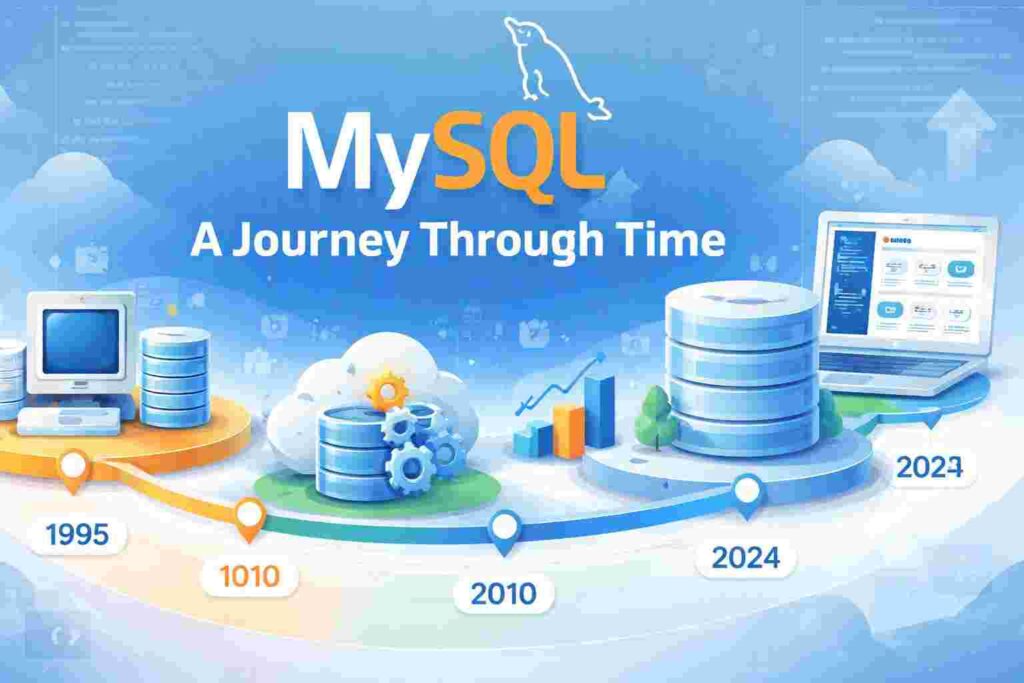
As we dive deeper into this exploration, we will discuss significant milestones in the history of MySQL, its evolving features, and how it compares to other database systems. This journey through time will highlight the innovative forces that have shaped MySQL and its pivotal role in the database landscape.
The Birth of MySQL
The inception of MySQL dates back to 1994 when Michael “Monty” Widenius, along with David Axmark and Allan Larsson, began developing its core. The first official version, MySQL 1.0, was released in 1995. The foundational idea was to create a database that excelled in speed and simple usability. It was built using the C and C++ programming languages, and at its core, the system employed the client-server architecture, paving the way for remote database interactions.
Initial requirements for MySQL came from the need for a fast solution that could handle the basic needs of various applications. The developers aimed for MySQL to use a structured query language (SQL) for its database interactions, which provided familiarity to users coming from other database systems. This direction not only satisfied developers’ expectations but also helped establish SQL as the de-facto language for data management.
A critical aspect during its early phases was the acquisition of community feedback. By making MySQL an open-source project, its creators encouraged developers worldwide to contribute to its enhancement. This approach not only accelerated innovation but also allowed users to adapt MySQL to their specific requirements within various applications.
Key Features That Defined MySQL
Throughout its journey, MySQL introduced numerous features that catered to the evolving requirements of developers. Among the standout characteristics were partitioning, replication, and the native implementation of SQL standards. These capabilities not only fortified MySQL’s performance but also played a significant role in offering a competitive edge over rivals.
One of MySQL’s defining features is its support for various storage engines, like InnoDB and MyISAM. InnoDB, for instance, brought ACID compliance, which ensured reliability during transactions. Meanwhile, MyISAM, which was prevalent in earlier versions, provided fast read operations. This flexibility allowed developers to choose storage methods based on their application’s needs, a practice that resonated with various industries.
Moreover, MySQL’s enhancement in handling large datasets has made it increasingly relevant amidst growing data requirements. Features like full-text indexing helped users streamline search queries, crucial for applications intending to provide efficient data retrieval. Such characteristics exemplified how MySQL adapted to the mounting expectations of users, continuously solidifying its stature in the marketplace.
MySQL’s Growth and Adoption
The early 2000s saw a significant acceleration in MySQL’s adoption across various industries. Its versatility made it suitable for web applications and enterprise solutions alike, which, in turn, expanded its user base. Companies began to leverage MySQL for content management systems (CMS) like WordPress, enhancing its visibility within the developer community while also fueling its growth.
As open-source software gained traction, MySQL became a go-to solution not only due to its licensing but also for its support within developer frameworks. Popular applications like Facebook and Twitter adopted MySQL as their database of choice, showcasing its capacity to handle vast amounts of concurrent connections and high data volumes.
This period also marked a notable presence of MySQL at technology conferences and events, catalyzing education around its capabilities and establishing a strong developer advocate culture. Internally, initiatives focusing on community engagement through forums, documentation, and contributions fostered not only growth but also a sense of belonging among users. This nurtured a rich ecosystem around MySQL, leading to the development of third-party tools and frameworks focused on enhancing usability and performance.
Acquisition by Sun Microsystems
In 2008, Sun Microsystems acquired MySQL AB for approximately $1 billion, placing MySQL alongside the hardware and software conglomerate’s extensive portfolio. This acquisition aimed to enhance Sun’s offerings and place them in a competitive position against rivals, such as Oracle. However, the acquisition led to a significant concern within the open-source community regarding MySQL’s future and how it would be maintained.
Post-acquisition, Sun continued to invest in MySQL’s development, promoting its growth by maintaining its open-source status while introducing new features. The advanced capabilities included enhanced security features, improved performance, and scalability to better support enterprise-level applications. However, some within the community feared that these enhancements might prioritize commercial interests over community needs.
For many developers, these developments underscored an essential lesson about open-source software: while large corporations bring resources and support, maintaining a balance between commercial goals and community values is crucial. This tension remains a key consideration for open-source projects as they scale.
Transition to Oracle Corporation
The landscape shifted again in 2010 when Oracle Corporation acquired Sun Microsystems and, subsequently, MySQL. While this acquisition propelled MySQL into the fold of a major player in database management, it raised apprehensions about the future of an open-source project under a corporate umbrella.
Despite these concerns, Oracle pledged to continue supporting MySQL as a leading open-source database solution. The investment led to significant improvements, including features aimed at enterprise-level functionality, such as enhanced replication features, better backup, and recovery tools, positioning MySQL for seamless handling of high-demand workloads.
During this transitional phase, Oracle emphasized the importance of community engagement by rolling out programs for developers to contribute. This approach demonstrated that MySQL’s open-source ethos would be preserved, and the tool would continue evolving with community-driven innovation. Nonetheless, many developers remained skeptical, highlighting ongoing debates about vendor-lock-in and the consequences of relying on a single corporate entity.
Modern Features of MySQL
As MySQL evolved, its features diversified to accommodate the emerging technology landscape. The introduction of JSON support in version 5.7 marked a notable advancement, allowing developers to store and query JSON data directly in MySQL databases. This flexibility proved invaluable in web-based applications that rely on rapidly changing data structures.
Additionally, the introduction of MySQL Cluster enabled horizontal scaling and SMS load balancing across multiple servers, making it easier to handle large-scale applications. This capability addressed a common pain point for businesses with increasing data needs and provided developers a way to improve system reliability further.
Moreover, performance optimizations, such as better query execution, indexed performance improvements, and adaptive hash indexing, have all contributed to MySQL’s efficiency. As the demand for speedy data retrieval increases, these enhancements are crucial in ensuring that MySQL maintains its position as a reliable database management solution.
Real-World Applications of MySQL
The versatility of MySQL has led to its integration into numerous applications across different industries. Popular platforms like WordPress, Joomla, and Drupal depend on MySQL for managing content and users. These applications leverage MySQL’s features to provide a seamless experience for users while simplifying complex data management behind the scenes.
Another prominent example is the bicycle-sharing platform Mobike, which utilizes MySQL to manage its user and vehicle data efficiently. The platform’s scale has influenced how MySQL can be employed in real-time environments, where timely access to data enhances productivity and user experience.
Moreover, MySQL has increasingly found its relevance in data science and analytics. Applications demanding real-time data analysis employ MySQL’s capabilities to swiftly retrieve and analyze data for informed decision-making. Such practical implementations showcase MySQL’s enduring usefulness, transcending its original intent as merely a lightweight database solution.
Common Misconceptions About MySQL
As MySQL’s popularity has grown, so have various myths and misconceptions. One of the most common is the notion that MySQL cannot handle large datasets. While it is true that earlier versions had limitations, modern versions of MySQL have proven their capabilities in managing vast collections of data, often scaling to terabyte levels without significant performance degradation.
Another misconception is that MySQL is only suitable for small applications or websites. This notion stems from its early adoption in personal projects. However, MySQL is now a preferred choice for multinational corporations and web giants due to its robustness, scalability, and advanced features that meet enterprise needs.
Lastly, there are beliefs that MySQL is inferior compared to other database systems like PostgreSQL or Oracle. While each database solution has its strengths and weaknesses, the choice ultimately depends on specific project requirements. It is vital to assess each scenario comprehensively before determining the best database technology to employ.
MySQL in the Cloud
In recent years, cloud computing has revolutionized how databases are deployed and managed. MySQL’s compatibility with cloud platforms, like Amazon RDS and Google Cloud SQL, has streamlined database management, offering businesses a scalable and flexible environment for their applications. Cloud-based MySQL services allow teams to deploy databases quickly without the administrative overhead of traditional setups.
Moreover, cloud providers enhance MySQL’s performance through automated backups, scaling, and maintenance tools, improving application reliability and reducing downtime. This has encouraged enterprises to lean towards cloud deployments, making MySQL’s flexibility evident in the cloud context.
Some enterprises opt for hybrid approaches, employing both on-premise and cloud systems to cater to their needs while maintaining performance and security. These advances illustrate how MySQL has adapted to the changing landscape, remaining vital in ensuring efficient data management across various infrastructures.
The Community that Drives MySQL
The strength and innovation surrounding MySQL can largely be attributed to its vibrant community. MySQL user groups, forums, and conferences offer incredible resources for both new and seasoned developers. These platforms provide a space for sharing solutions, discussing problems, and even contributing code to the MySQL project.
Many developers actively participate in creating extensions and third-party tools that complement MySQL’s core functionality. Such community-driven contributions have enhanced MySQL’s adaptability, making it more versatile and powerful for varying projects, reflecting a culture where collaboration leads to innovation.
The community focus cultivates an educational environment where new users can seek guidance and learn best practices from experienced developers. This ecosystem fosters a cycle of continuous learning and growth that benefits MySQL as a whole, ensuring its ongoing evolution reflects users’ needs.
Conclusion
In summary, the history of MySQL is a testament to its resilience, adaptability, and the strong community that supports it. From its roots as a small project to becoming a significant player in the database realm, MySQL has continually evolved to meet the demands of modern applications. Understanding its history provides context to appreciate its current capabilities and future potential.
As we move forward into an increasingly data-driven world, MySQL’s ability to adapt and innovate will undoubtedly keep it relevant. Its continued development, backed by a vibrant community and corporate support, ensures that MySQL will remain a vital resource for developers and businesses alike.
FAQs
1. What is MySQL primarily used for?
MySQL is primarily used as a relational database management system (RDBMS). It is utilized for storing, retrieving, and managing data for various applications. Notably, MySQL is often leveraged in web applications, content management systems, and enterprise software due to its reliability and scalability.
2. How is MySQL different from other database systems?
MySQL differentiates itself through its open-source nature, ease of use, and robust community support. While other systems like PostgreSQL and Oracle provide unique features, MySQL’s straightforward installation, setup, and support for numerous programming languages make it a favorite among developers.
3. Can MySQL handle large datasets?
Yes, modern versions of MySQL can handle large datasets efficiently. With advancements in indexing, storage engines, and system architecture, MySQL can manage databases that are several terabytes in size while maintaining performance. Its clustering and partitioning capabilities further enhance its efficiency with large data requirements.
4. What is the advantage of using MySQL in cloud computing?
Using MySQL in cloud environments allows for scalable, on-demand database management without the complexities of traditional setups. Cloud services often provide automated backups, scaling, and high availability features, enabling businesses to focus on development rather than infrastructure maintenance.
5. Is MySQL still relevant today?
Absolutely! MySQL continues to be a leading database solution, widely adopted by developers and enterprises. Its ongoing updates to modern features, capabilities, and compatibility with various frameworks maintain its relevance in the ever-evolving tech landscape.
6. What kinds of applications typically use MySQL?
MySQL is commonly used in web applications, content management systems, e-commerce platforms, and data analytics applications. Its robust performance and flexibility make it suitable for projects ranging from small blogs to large enterprise systems with extensive data handling needs.
7. How can developers get involved with the MySQL community?
Developers can engage with the MySQL community through forums, user groups, and conferences. Participating in discussions, contributing code, and collaborating on MySQL-related projects can enhance skills and knowledge while fostering connections with other developers.
8. What are some common pitfalls when using MySQL?
Common pitfalls include neglecting proper indexing, which can lead to slow query performance, and not utilizing transactions appropriately, risking data integrity. Additionally, failing to perform regular backups can cause significant issues during data recovery. Developers should invest time in learning best practices to avoid these common mistakes.
| MySQL Version | Key Features Introduced | Year Released |
|---|---|---|
| MySQL 3.23 | Basic replication and query caching | 1998 |
| MySQL 4.0 | Improved performance and table-level locking | 2001 |
| MySQL 5.0 | Stored procedures and triggers | 2005 |
| MySQL 5.7 | JSON data type and optimized replication | 2015 |
| MySQL 8.0 | Improved security and support for window functions | 2018 |