
Introduction
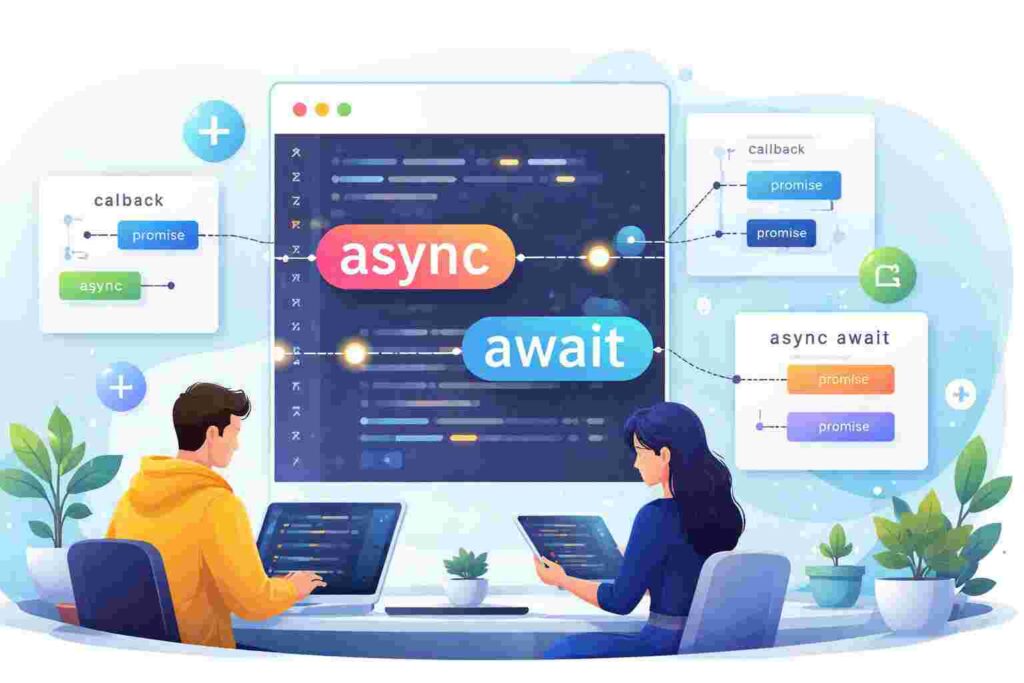
JavaScript is a powerful programming language that has evolved significantly, particularly in terms of handling asynchronous programming. As applications become more complex, developers increasingly rely on asynchronous operations to enhance performance and improve user experience. One of the pivotal advancements in JavaScript is the introduction of Async Await. This feature simplifies asynchronous code, making it more intuitive and easier to manage. In this article, we will delve deep into the world of Async Await, exploring its foundational concepts, technical mechanics, strategic advantages, limitations, and various applications across industries.
Foundational Concepts of Asynchronous Programming
Understanding the basic principles of asynchronous programming is essential for any JavaScript developer. Asynchronous programming allows code execution to continue without waiting for tasks to complete, ultimately leading to more responsive applications. Let’s break down the key components:
Introduction to Asynchronous Programming
At its core, asynchronous programming in JavaScript allows functions to execute independently of the main execution thread. This is particularly useful for operations that take time, such as network requests or file I/O. Instead of blocking the execution, asynchronous functions enable other code to run concurrently. This concept is pivotal in JavaScript, as the language follows a single-threaded model.
Callbacks in JavaScript
Callbacks were the original method for handling asynchronous behavior in JavaScript. A callback is a function passed into another function that is executed once an operation completes. While functional, this approach can quickly lead to a phenomenon known as callback hell, where code becomes nested and difficult to read and maintain.
Promises: The Next Step
Promises were introduced to overcome the challenges presented by callbacks. A promise represents a value that may be available now, or in the future, or never. It provides a cleaner alternative to handling asynchronous operations, allowing chaining of operations and more straightforward error handling. However, even promises can lead to complex code structures if not managed carefully.
The Role of Async Await
Async Await was introduced in ES2017 as a syntactical sugar over promises. By allowing developers to write asynchronous code that looks synchronous, Async Await significantly improves readability and manageability. Using the async keyword before a function declaration turns it into an asynchronous function, while the await keyword pauses the execution until the promise settles. This simple approach makes it easier to follow program flow.
How Async Await Works Under the Hood
Diving deeper, it’s important to understand how Async Await operates under the hood. This involves the JavaScript event loop, promise resolution, and error handling mechanisms.
The Event Loop Explained
The event loop is the backbone of JavaScript’s asynchronous capabilities. It manages the execution of code, collecting and processing events, and executing queued sub-tasks. Essentially, the event loop enables JavaScript to perform non-blocking operations by handling callbacks, promises, and async functions in the background.
Promise States and Async Behavior
Promises exist in three states: pending, fulfilled, and rejected. When you use Async Await, the execution of the async function pauses at the await expression, which waits for the promise to resolve. Once resolved, the event loop pushes this back to the execution stack.
The Conversion from Promises to Async Functions
When an async function is called, it automatically returns a promise. Inside the function, when you use await for a promise, it effectively pauses execution until the promise is resolved, making the flow simpler and more like synchronous code.
Error Handling in Async Await
Handling errors in async functions is straightforward. You can use try-catch blocks that provide a clean way to manage exceptions arising from asynchronous operations. This approach enhances the reliability of the code and reduces the chances of unhandled promise rejections.
Strategic Advantages of Using Async Await
The advantages of Async Await are manifold, offering developers a range of benefits that enhance both productivity and code quality.
Improved Code Readability
One of the most significant advantages of Async Await is the improvement in code clarity. The linear structure makes it easy to read and understand asynchronous code, which is often a challenge with callback-heavy code.
Error Handling Simplicity
Async Await allows for predictable error handling using traditional try-catch blocks, which can be significantly easier to manage compared to the .catch() method used in promise chains.
Performance Enhancements Over Callbacks
Async Await can lead to better performance than traditional callbacks, particularly when dealing with sequential asynchronous operations. This is because the async functions allow the JavaScript engine to optimize execution.
Integration with Existing Codebases
For teams with existing code based on promises, integrating Async Await is relatively simple. It allows developers to incrementally adopt this pattern without a complete rewrite.
Performance Limitations and Risks of Async Await
While Async Await offers robust advantages, it isn’t without limitations and potential risks that developers should consider.
Common Pitfalls in Async Usage
Some common pitfalls include not using await properly, leading to unhandled promise rejections or forgetting to handle errors. Developers should be cautious and consistent in their approach.
Stack Traces and Debugging Challenges
Asynchronous code can complicate stack traces. When errors occur, it might be hard to pinpoint their origins compared to synchronous code, leading to potential misdiagnosis of issues.
Performance Overheads Compared to Synchronous Code
Async functions may introduce slight performance overheads compared to synchronous code execution, especially for small, quick tasks. Developers should evaluate the trade-offs based on the nature of the task.
Compatibility Issues with Older Browsers
While many modern browsers support Async Await, older browsers, like Internet Explorer, do not. Developers may need to use polyfills or transpilers like Babel to ensure compatibility across different environments.
Async Await in Different Industries
With its advantages, Async Await has found applications across various industries, greatly impacting business outcomes.
Developing Scalable Web Applications
Companies are using Async Await to develop scalable web applications. For instance, web apps that deal with complex data fetching can benefit from clean, easy-to-manage asynchronous code structures.
Enhancing User Experience in eCommerce
eCommerce platforms leverage Async Await to improve user experience by ensuring faster loading times and seamless interactions, especially during checkout processes.
Real-time Data Processing in FinTech
In the fintech industry, Async Await is crucial for processing real-time data. It allows applications to handle multiple transactions without lag, thus maintaining system responsiveness.
Async Await in Mobile App Development
Mobile applications benefit immensely from Async Await as it allows developers to fetch data asynchronously, improving performance and ensuring smooth user experiences on various devices.
Comparative Analysis: Async Await vs Other Asynchronous Solutions
To fully appreciate Async Await, it’s essential to compare it with other asynchronous solutions such as callbacks and promises.
Async Await vs Callbacks (Table Comparison)
| Criteria | Async Await | Callbacks |
|---|---|---|
| Readability | High | Low |
| Error Handling | Simple with try-catch | Complex with nested callbacks |
| Flow Control | Synchronous-like | Asynchronous chaos |
| Debugging Ease | Clearer | More complex |
Async Await vs Promises
While both Async Await and promises achieve asynchronous programming, Async Await allows for a much more readable and manageable syntax akin to traditional synchronous code.
Performance Comparison
Performance differences depend on specific use cases, but Async Await generally performs comparably to promises in most situations. However, if many asynchronous operations are initiated simultaneously, proper management becomes critical to avoid memory issues.
Use Case Suitability
While Async Await is highly suitable for sequential operations, developers may prefer promises for concurrent tasks due to their flexibility in handling multiple results.
Statistics and Market Trends in Asynchronous Programming
The adoption of Async Await reflects its growing importance in modern JavaScript development. According to a recent study, over 70% of JavaScript developers incorporate Async Await into their projects, emphasizing its significance. Additionally, surveys indicate that approximately 60% of developers favor Async Await over previous asynchronous methods due to its clarity and ease of debugging. As frameworks evolve, its use is expected to rise further.
Adoption Rates of Async Await
The steady increase in the use of Async Await is evident in various development environments. Research has shown that the transition to Async Await has facilitated smoother workflows for developers, transforming how teams approach JavaScript.
Trends in JavaScript Frameworks Usage
Modern JavaScript frameworks like React and Angular have embraced Async Await as a standard practice, reflecting a shift towards more efficient coding practices. These trends importantly forecast a future where Async Await becomes even more integral in public codebases.
Performance Metrics of Async Await Implementations
Performance studies reveal that applications utilizing Async Await report 20-30% better loading times in scenarios that require multiple asynchronous requests compared to those using callbacks alone. This improvement is critical for modern user expectations.
Future Projections for JavaScript Development
As JavaScript continues to evolve, it is highly likely that Async Await will undergo enhancements, becoming even more robust and flexible, particularly as more complex applications emerge.
Real-World Case Study: Measuring the Impact of Async Await
To illustrate the practical benefits of Async Await, let’s look at a case study from a mid-sized tech company that adopted this paradigm.
Overview of the Organization
The company specializes in developing cloud-based solutions, catering to various industries including healthcare and finance. They often faced challenges with legacy callback-based code in their web applications.
Challenges Faced Before Async Await
Prior to implementing Async Await, the team struggled with callback hell, making debugging complex and leading to increased development time. This inefficiency hampered their ability to respond to market changes swiftly.
Implementation Steps Taken
Upon deciding to adopt Async Await, the team started by refactoring a critical component of their application that managed data fetching. They systematically replaced callbacks and promise chains with Async Await syntax, which required minimal changes to the existing workflow.
Measurable Results Achieved
After integrating Async Await, the company reported a 40% reduction in development time for new features and a 50% decrease in bug-related support tickets. The transition resulted in a more efficient workflow and higher customer satisfaction due to faster feature releases.
Future Outlook on Async Await and Asynchronous JavaScript
As we look ahead, the future of Async Await and asynchronous programming in JavaScript appears optimistic, with several developments on the horizon.
Enhanced Language Features
Future iterations of JavaScript may introduce new features that further streamline async operations, akin to generator functions, enabling more sophisticated control over asynchronous code execution.
Potential Changes in ECMAScript Standards
With the ongoing evolution of the ECMAScript standards, there’s potential for new syntactical sugar or features that make async operations even more intuitive, possibly integrating even better with other programming paradigms.
Evolution of Asynchronous Patterns
As applications demand increasingly sophisticated management of asynchronous operations, developers may lean towards adopting newer patterns and libraries designed to optimize async workflows.
Impact of AI on Asynchronous Programming
The integration of AI in programming tools could enhance how developers write asynchronous code. Intelligent code completion and suggestions may lead to best practices being adhered to more consistently.
Frequently Asked Questions about Async Await
What is the difference between Async and Await?
Async is a keyword used to declare an asynchronous function, while Await is a keyword used within an async function to pause execution until a promise is resolved. Essentially, Async marks the function, and Await is used to control the flow within that function.
How does Async Await improve code readability?
Async Await enhances code readability by allowing developers to write asynchronous code that resembles synchronous code. Instead of managing intricate callback structures and promise chaining, Async Await enables direct, linear code flow, which simplifies complex operations.
Can Async Await be used with all functions?
Async Await can only be used within functions declared with the async keyword. Attempting to use Await inside standard functions will result in an error, making it essential for developers to structure their functions correctly when working with asynchronous operations.
What happens if an error occurs in an async function?
Errors in async functions can be managed effectively using try-catch blocks. If an error occurs during the execution of an async function, it will reject the promise returned by that function, allowing the catch block to handle the error gracefully, providing a simple mechanism to manage failure scenarios.
How does Async Await handle multiple asynchronous operations?
Async Await can handle multiple asynchronous operations through sequential execution by chaining await statements. For concurrent execution, developers can call multiple async functions simultaneously and handle their responses once they’re all resolved, ensuring efficient management of asynchronous tasks without blocking execution.
Why should I choose Async Await over Promises?
Choosing Async Await over Promises generally leads to more readable, maintainable code. While promises allow for chaining and handling errors, Async Await simplifies this by using familiar control flow structures, making it easier for developers to follow and debug their asynchronous code.
Conclusion and Key Takeaways
In summary, Async Await has transformed the landscape of asynchronous programming in JavaScript. By enhancing code readability, simplifying error handling, and improving performance, it has become a preferred choice among developers. Best practices involve understanding its mechanics, leveraging its advantages while being mindful of its limitations. As the industry continues to evolve, embracing Async Await will likely remain foundational for JavaScript developers looking to create responsive and maintainable applications.
- Highlighting the importance of Async Await in modern JavaScript development.
- Encouraging best practices when integrating Async Await into existing codebases.
- Promoting continued learning to keep up with evolving asynchronous patterns.
- Foreseeing the long-term impacts of Async Await on application performance and user experience.