
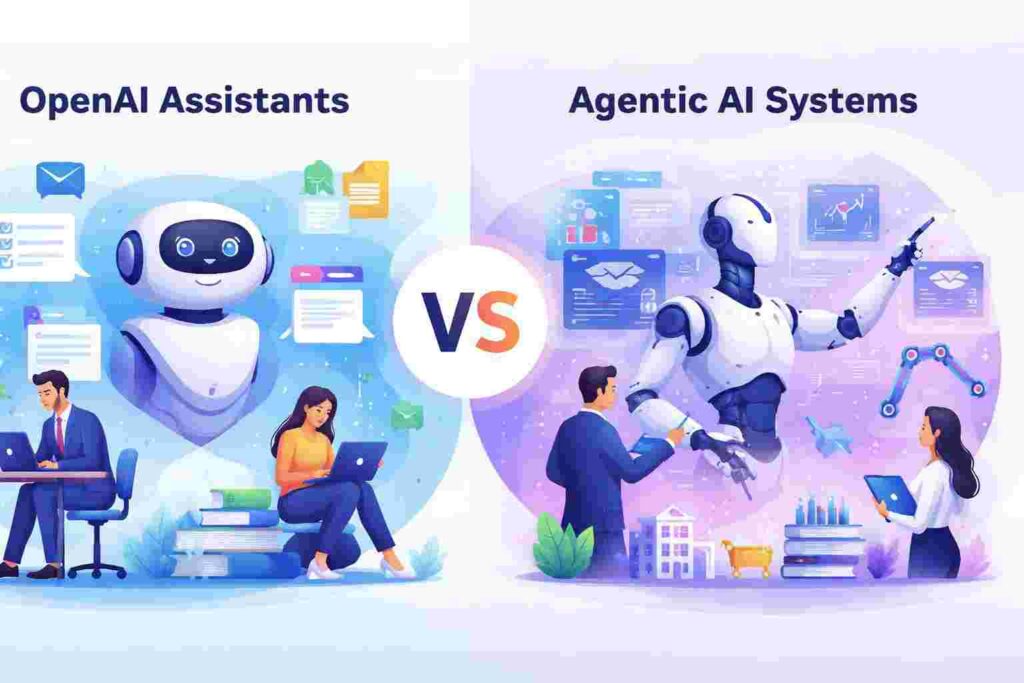
As the realm of artificial intelligence continues to evolve, understanding the intricate distinctions between OpenAI Assistants and Agentic AI Systems becomes crucial for businesses and consumers alike. This article delves into the core functionalities, business implications, technological frameworks, and future trajectories of these two distinct types of AI technologies. By examining their features, benefits, potential risks, and industry applications, we aim to provide a comprehensive understanding of how these systems operate and support various sectors.
Understanding OpenAI Assistants
OpenAI Assistants have revolutionized human-computer interaction. These systems primarily focus on enhancing conversational capabilities, enabling users to communicate with machines in a natural and intuitive manner. Let’s explore the fundamental aspects of OpenAI Assistants.
Definition
OpenAI Assistants are AI-driven platforms designed to engage users in a dialogue, capable of understanding and generating human-like responses. They leverage deep learning models, particularly based on generative transformer architectures, to process language and deliver relevant information or perform tasks as instructed.
Key Features
- Natural language understanding and processing
- Context-aware interactions
- Task automation capabilities
- Multilingual proficiency
- Continuous learning from user interactions
Common Applications
- Customer support services
- Personalized learning experiences
- Content generation for marketing
- Virtual assistants for productivity tools
- Interactive gaming environments
Defining Agentic AI Systems
In contrast to OpenAI Assistants, Agentic AI Systems represent a broader category of autonomous systems capable of executing tasks without continuous human oversight. These systems aim for a higher degree of autonomy and decision-making ability.
Definition
Agentic AI Systems are sophisticated AI frameworks that can perceive their environment, make decisions, and act upon them while learning from their experiences. They focus on achieving specific objectives through various means, emphasizing adaptability and insight-driven functioning.
Core Principles
- Autonomy in decision-making
- Goal-oriented behavior
- Self-learning and adaptation
- Interaction with dynamic environments
- Multi-agent cooperation
Distinguishing Aspects
What sets Agentic AI Systems apart is their ability to function independently, often involving elements such as reinforcement learning and situational adaptation. These systems can analyze numerous variables and adjust their strategies accordingly, making them suitable for more complex industrial tasks.
Technical Mechanisms Behind Each System
Both OpenAI Assistants and Agentic AI Systems use sophisticated technologies, though their frameworks differ significantly. Understanding these underlying technologies helps clarify how each system achieves its objectives.
Algorithmic Frameworks
OpenAI Assistants typically employ transformer-based models like GPT (Generative Pre-trained Transformer) that can generate text based on context and user input. In contrast, Agentic AI Systems leverage a combination of supervised and unsupervised learning techniques, neural networks, and multi-agent systems that enable them to navigate complex tasks independently.
Data Processing Techniques
- Data pre-processing and cleaning
- Feature extraction and transformation
- Real-time processing capabilities for Agentic AI
- Contextual data utilization for OpenAI Assistants
- Adaptive learning algorithms
Interfacing Technology
Both types of systems utilize various interfaces, from chatbots and voice assistants for OpenAI to API integrations and command platforms for Agentic AI Systems. The choice of interface often dictates usability and integration capabilities within existing infrastructures.
Business Impact Across Industries
Examining how each of these systems impacts different sectors sheds light on their practical applications and the value they offer to businesses. As companies increasingly adopt AI technologies, assessing their specific benefits is critical.
Healthcare
- Patient engagement through virtual assistance
- Automating administrative tasks to reduce overhead costs
- Real-time data analysis for decision-making
- Predictive analytics for treatment plans
- Remote monitoring enhancements
Finance
- Fraud detection through advanced pattern recognition
- Customer service automation, reducing response times
- Algorithmic trading strategies powered by AI insights
- Personalized financial advising through predictive models
- Risk management assessment
Customer Service
- Improved response times with automated chatbots
- Enhanced customer engagement through personalized interactions
- Data-driven insights for better service delivery
- 24/7 support availability
- Cost savings through reduced personnel requirements
Manufacturing
- Predictive maintenance to reduce downtime
- Resource optimization using AI-driven analytics
- Supply chain improvements with real-time data
- Quality control automation
- Worker safety enhancements through monitoring systems
Strategic Advantages of Each AI Approach
The strategic advantages of utilizing either OpenAI Assistants or Agentic AI Systems may influence decision-making processes. Understanding these benefits helps organizations align their operations with technological capabilities.
Efficiency Gains
OpenAI Assistants enhance operational efficiency through automations, enabling organizations to delegate simpler tasks while focusing on high-priority functions. Conversely, Agentic AI boasts the ability to self-optimize and streamline complex processes by making autonomous decisions based on dynamic data.
Cost Reduction
- Lower operational costs from reduced staffing needs
- Increased accuracy leads to fewer errors and rework
- Automated systems result in fewer resource allocations
- Time savings contribute to faster project turnarounds
- Minimized downtime through predictive capabilities
User Experience Enhancement
OpenAI Assistants provide an engaging user experience, catering interactions to individual preferences and thereby increasing user satisfaction. Agentic AI enhances user experience by seamlessly integrating into workflows, creating intelligent systems that adapt to user needs without excessive oversight.
Limitations and Risks Associated with Each System
While the benefits of AI technologies are significant, awareness of their limitations and associated risks is essential. Both systems face challenges that organizations must navigate when integrating AI into their operations.
Data Privacy Issues
- Potential misuse of personal data
- Vulnerability to data breaches
- Regulatory compliance complexities
- Transparency in data usage
- Tech nihilism – disconnection due to over-reliance on AI
Bias and Ethical Concerns
AI systems are trained on existing datasets, which can introduce bias and perpetuate systemic inequalities. This is particularly concerning in sensitive applications such as hiring practices or credit assessments. It is imperative for developers to implement rigorous ethical frameworks and continuous monitoring to mitigate these risks.
Dependence on Technology
Both OpenAI Assistants and Agentic AI Systems may lead organizations to overly rely on AI, which could result in diminished critical thinking and problem-solving abilities among employees. Encouraging a balanced approach that includes human oversight alongside AI involvement is key.
Comparative Evaluation of OpenAI Assistants and Agentic AI Systems
A detailed comparison of the two AI systems reveals nuanced differences in their capabilities and effectiveness. Here, we summarize their features and overall performance metrics in a structured format.
| Feature | OpenAI Assistants | Agentic AI Systems |
|---|---|---|
| Task Autonomy | Limited to specific interactions | High, with self-directed capabilities |
| Learning Capability | Continuous through interaction | Dynamic adaptation over time |
| User Engagement | Conversational style interactions | Task-oriented, goal-driven |
| Scalability | Moderate due to focused applications | Highly scalable across various domains |
| Implementation Complexity | Relatively simpler | More complex, requiring integration of multiple systems |
Statistics and Market Trends in AI
The rapid evolution and adoption of AI technologies are reflected in market trends and statistics. Understanding these metrics is essential for assessing the viability of OpenAI Assistants and Agentic AI Systems in your strategic planning.
Market Growth Rates
The AI market is projected to grow from $139.4 billion in 2022 to $733.7 billion by 2027, reflecting a compound annual growth rate (CAGR) of 39.4%. This growth is fueled by increased adoption of AI across sectors, including healthcare, finance, and retail.
User Adoption Statistics
- Approximately 70% of companies reported AI integration into their operations in 2023.
- 75% of consumers prefer using AI solutions for customer service inquiries.
- 50% of businesses have increased their AI budget in the past year.
- 30% of firms are investing in AI-related research and development.
- 65% of businesses expect AI to enhance their decision-making capabilities significantly.
Real-World Case Studies and Measurable Outcomes
Highlighting successful implementations of OpenAI Assistants and Agentic AI Systems can provide valuable insights into their performance and measurable impact on organizations.
Case Study 1: OpenAI Assistants
A leading e-commerce platform implemented OpenAI Assistants to enhance their customer support experience. Prior to integration, response times averaged 15 minutes, with customer satisfaction (CSAT) ratings at 70%. Post-implementation of OpenAI, response times improved to under 1 minute, and CSAT ratings climbed to 90%, demonstrating a direct positive correlation with the assistant’s natural language processing capabilities.
Case Study 2: Agentic AI Systems
A manufacturing firm adopted Agentic AI Systems to optimize their supply chain processes, focusing on predictive analytics for inventory management. Before this system, the company experienced a 15% annual loss due to stockouts and overstock situations. After implementing the Agentic AI framework, they reported a reduction in losses to 5%, illustrating substantial ROI and operational efficiency gains.
Outcomes and Learnings
The outcomes from these case studies underscore the necessity of aligning AI initiatives with specific organizational goals. Both OpenAI Assistants and Agentic AI Systems have demonstrated significant potential to not only improve operational efficiency but also drive substantial customer satisfaction and loyalty when properly implemented.
Future Outlook for AI Systems
The trajectory for AI systems appears bright, with numerous innovations on the horizon. Understanding the future of these technologies can inform businesses’ strategic decisions moving forward.
Emerging Technologies
- Development of more advanced natural language processing models
- Integration of AI with the Internet of Things (IoT)
- Greater emphasis on ethical AI and responsible algorithms
- Cross-disciplinary innovations combining AI with fields like bioengineering
- Enhanced user interface designs for better interaction
Potential Innovations
Innovations in AI technology will continue to be driven by the need for increased personalization and automation. Future OpenAI Assistants may become indistinguishable from human interactions, improving engagement. Meanwhile, Agentic AI Systems are expected to become increasingly autonomous, capable of making complex decisions in real time without human interference.
Future Market Projections
The future market landscape indicates a substantial increase in investment in AI technologies, with expected funding levels reaching over $100 billion by 2025. As organizations recognize the value of both OpenAI Assistants and Agentic AI Systems, we anticipate enhanced competition among technology providers, resulting in rapid advancements and rich functionalities.
Frequently Asked Questions
What are the key differences?
The main differences between OpenAI Assistants and Agentic AI Systems lie in their level of autonomy and complexity. OpenAI Assistants primarily focus on enhancing conversational interactions and tasks, while Agentic AI Systems operate independently, making decisions based on their autonomous goals and dynamic surroundings. This fundamental distinction shapes their applications and operational capacities.
How do they handle data?
OpenAI Assistants handle data primarily through interaction-based learning, where they adapt to users’ language and preferences over time. They rely on large datasets for training and refinement. In contrast, Agentic AI Systems utilize real-time data processing, allowing them to make informed decisions quickly based on current environmental factors, enabling a responsive and proactive approach to challenges.
What industries benefit most?
Industries such as healthcare, finance, customer service, and manufacturing stand to benefit significantly from both AI systems. Healthcare professionals use OpenAI Assistants for patient engagement and diagnostics, while Agentic AI Systems support manufacturing with real-time analytics. The versatility of both systems allows them to penetrate various industries effectively, enhancing scalability and adaptability.
Are there ethical considerations?
Yes, ethical considerations are paramount when integrating AI technologies. Issues such as algorithmic bias, data privacy, and the potential for misuse of conversational AI in deceptive practices pose challenges developers must address. It is crucial for organizations to establish strict ethical guidelines and transparency to mitigate these risks while maximizing the potential benefits of both systems.
What is the future of AI?
The future of AI is poised for significant innovation driven by advancements in technology and a growing understanding of ethical frameworks. We can expect more robust AI systems capable of deeper context understanding and greater autonomy. As businesses embrace these technologies, they will foster a more collaborative human-AI ecosystem, ultimately reshaping how industries operate.
How to choose between them?
Choosing between OpenAI Assistants and Agentic AI Systems will depend on your organization’s specific needs. If your focus is on enhancing customer interactions and automating simple tasks, then OpenAI Assistants may be ideal. Conversely, if your goals include improving operational autonomy and tackling complex decision-making processes, Agentic AI Systems would be more fitting. It is vital to evaluate your objectives thoroughly before making a decision.
Conclusion: Choosing the Right AI System
In conclusion, both OpenAI Assistants and Agentic AI Systems hold immense potential to transform industries through enhanced efficiency and problem-solving capabilities. Understanding their fundamental differences, advantages, limitations, and applicability across sectors aids businesses in making informed choices. Looking forward, businesses must remain adaptable, leveraging AI advancements to thrive in an increasingly competitive landscape.