- The Command Structure: Hierarchical Agent Architectures in Modern Software
- The Hierarchical Organizational Model
- Context Abstraction: The Secret to Hierarchical Scalability
- Implementing a Supervisor Delegation Node in Python
- Comparing Hierarchical vs. Peer-to-Peer Swarms
- Related Architectural Deep Dives
- Frequently Asked Questions
The Command Structure: Hierarchical Agent Architectures in Modern Software
When engineering teams scale from two or three autonomous agents to dozens of collaborating workers, decentralized peer-to-peer communication breaks down. In a decentralized network with $N$ agents, the number of possible communication channels scales quadratically as $\mathcal{O}(N^2)$. Context windows quickly fill with chatter, responsibilities blur, and overall system throughput grinds to a halt.
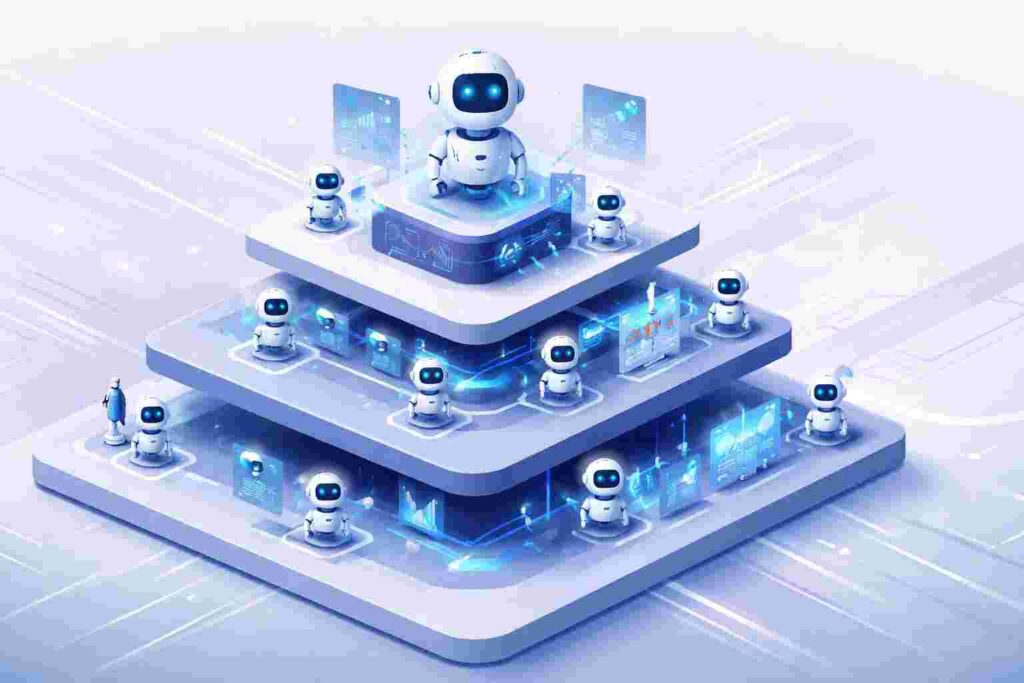
Hierarchical Agent Architectures solve this scaling bottleneck by establishing structured organizational hierarchies modeled after high-performing engineering organizations. A lead Supervisor / Orchestrator decomposes high-level goals, delegates discrete subtasks to specialized Department Managers, who in turn command focused Worker Agents.
In this technical architecture guide, we analyze hierarchical delegation topologies, construct a multi-tiered supervisor network in Python, evaluate context pruning across hierarchy tiers, and compare hierarchical models against flat agent swarms.
The Hierarchical Organizational Model
Multi-Tier Hierarchical Architecture:

                      ┌──────────────────────┐
                      │  Executive Director  │ (Strategic Goal)
                      └──────────┬───────────┘
                                 │
         ┌───────────────────────┴───────────────────────┐
         ▼                                               ▼
┌──────────────────┐                           ┌──────────────────┐
│ Research Manager │                           │  Build Manager   │ (Department Level)
└────────┬─────────┘                           └────────┬─────────┘
         │                                              │
   ┌─────┴─────┐                                  ┌─────┴─────┐
   ▼           ▼                                  ▼           ▼
┌──────┐    ┌──────┐                           ┌──────┐    ┌──────┐
│ Web  │    │ PDF  │                           │ Code │    │ Test │ (Worker Level)
│Scraper│   │Reader│                           │Author│    │Runner│
└──────┘    └──────┘                           └──────┘    └──────┘
Context Abstraction: The Secret to Hierarchical Scalability
The primary advantage of a hierarchical architecture is Context Abstraction. Worker agents deal with granular, high-token data: raw HTML scrapes, stack traces, and database schemas. However, they report back to their manager with compressed, structured summaries.
The Executive Director never reads raw HTML or terminal logs. By receiving only clean, synthesized department reports, the top-level orchestrator’s context window remains clean, allowing it to maintain strategic reasoning over long operational workflows.
Implementing a Supervisor Delegation Node in Python
Below is a working implementation of a Supervisor Node that dynamically routes tasks to specialized worker departments using structured function calling:
from openai import OpenAI
from pydantic import BaseModel, Field
from typing import Literal

client = OpenAI()

class DelegationDecision(BaseModel):
    next_worker: Literal["ResearchLead", "CodeArchitect", "SecurityAuditor", "FINISH"] = Field(
        description="The next specialized department to delegate to, or FINISH if the goal is met."
    )
    delegation_brief: str = Field(
        description="Clear, actionable instructions specifying what the assigned agent must produce."
    )

def supervisor_router(global_goal: str, department_updates: str) -> DelegationDecision:
    prompt = f"""
    Global Enterprise Objective: {global_goal}

    Current Progress Across Departments:
    {department_updates}

    Evaluate system state. Determine which specialized department must act next to progress toward the objective.
    """

    completion = client.beta.chat.completions.parse(
        model="gpt-4o",
        messages=[{"role": "user", "content": prompt}],
        response_format=DelegationDecision
    )
    return completion.choices[0].message.parsed
Comparing Hierarchical vs. Peer-to-Peer Swarms
| Dimension | Hierarchical Architecture | Peer-to-Peer Swarm |
|---|---|---|
| Communication Complexity | $\mathcal{O}(N)$ (Linear through managers) | $\mathcal{O}(N^2)$ (Quadratic chatter) |
| Decision Determinism | High (Clear chain of command) | Moderate (Emergent consensus) |
| Context Isolation | Optimal (Workers never leak raw context to top) | Poor (Shared memory fills quickly) |
| Fault Tolerance | Supervisor represents single point of failure | High (No single bottleneck) |
Related Architectural Deep Dives
Continue expanding your technical depth with our related engineering guides:
- What is Agentic AI: Comprehensive guide on autonomous agentic systems and cognitive loops. Explore the complete guide: What is Agentic AI.
- Production RAG Pipeline: Architecting production RAG with Python, LangChain, and ChromaDB. Explore the complete guide: Production RAG Pipeline.
Frequently Asked Questions
How deep should an agent hierarchy be?
In most commercial applications, a 2-tier or 3-tier hierarchy is optimal (Director ──► Manager ──► Worker). Hierarchies deeper than 3 levels introduce unnecessary latency and telephonic degradation as instructions pass down the chain.
Can workers in different departments talk directly to each other?
Strict hierarchies route cross-department requests through managers. However, modern “hybrid” architectures allow lateral peer-to-peer data requests when explicitly authorized by an orchestrator ticket.
What happens if a supervisor agent makes a bad routing decision?
Production systems implement state rollback checkpoints and an independent “Auditor” agent that verifies whether the supervisor’s delegations adhere to project milestones.
Related Modular Guides & Next Steps
- Next in Series: Explore Coordination and Conflict Resolution in Agents.
- Previous Guide: Explore Task Delegation Between Agents: Practical Developer Guide.