Introduction
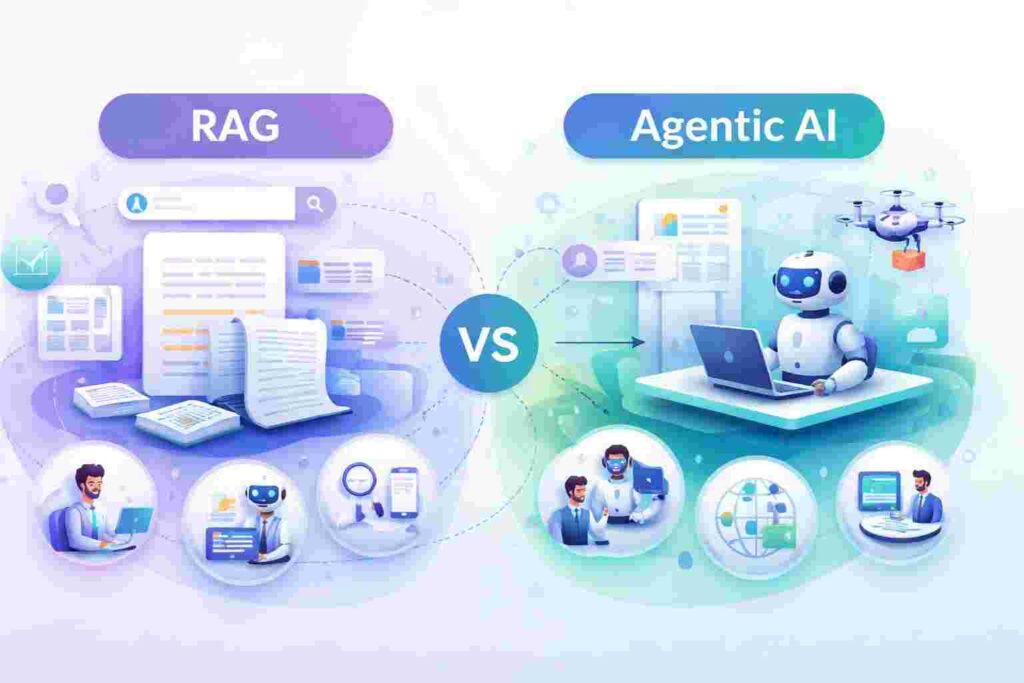
In the rapidly evolving landscape of artificial intelligence, Retrieval-Augmented Generation (RAG) and Agentic AI are two innovative technologies that serve distinct purposes yet share the common goal of maximizing efficiency and intelligence. As businesses increasingly rely on AI solutions, understanding when to use RAG vs Agentic AI becomes vital for optimally addressing specific challenges. This article delves into both technologies to highlight their functions, applications, and the contexts in which they shine.
Understanding RAG and Agentic AI
Before diving into advanced considerations, it’s essential to define these two pivotal technologies.
Definition of RAG
Retrieval-Augmented Generation combines traditional natural language generation with retrieval mechanisms. It harnesses external databases to improve accuracy and relevance in generating responses, enabling AI to provide not only pre-trained information but also dynamically accessed insights. The blend allows for a more **contextually aware response**, adapting based on real-time data.
Definition of Agentic AI
Agentic AI, on the other hand, embodies autonomous systems capable of perceiving environments, making decisions, and executing actions without human intervention. These systems employ complex algorithms to operate independently, often resembling decision-making processes found in living beings. Their adaptive nature allows them to optimize across numerous variables in real time.
Core Functionalities
- RAG leverages knowledge repositories for enriched content generation.
- Agentic AI performs tasks autonomously based on learned behavior and environmental feedback.
- RAG enhances traditional AI capabilities with a focus on retrieval accuracy, while Agentic AI specializes in decision-making and task execution.
- RAG often requires continuous data updates for best performance, whereas Agentic AI models learn from ongoing interactions.
Differences in Technology
The technological backbone of RAG and Agentic AI differs significantly. RAG systems typically integrate retrieval models with natural language processing, allowing them to fetch and synthesize information effectively.
Conversely, Agentic AI relies on advanced neural networks, reinforcement learning, and multi-agent frameworks. These systems exhibit complex behaviors through interaction with their environments, thereby creating unique operational capabilities. The tech distinctions lead to varied deployment scenarios.
Technical Mechanisms Behind RAG and Agentic AI
To understand the mechanics behind RAG and Agentic AI, one needs to explore their architecture and data-processing methods.
Architecture of RAG
RAG architecture integrates two main components: a retriever and a generator. The retriever identifies the most relevant information from a larger corpus, which is then synthesized by the generator into coherent outputs.
Architecture of Agentic AI
Agentic AI systems are often built upon a layered framework, consisting of perception, reasoning, and action layers. The perception layer collects data from the environment, the reasoning layer performs logic and decision-making processes, and the action layer executes the chosen actions.
Data Retrieval Processes
- RAG employs semantic matching to ensure relevant results from data sources.
- Data fetching can be real-time or scheduled, depending on the use case.
- Algorithm enhancements ensure accuracy, while user inputs increase relevancy.
Natural Language Processing Techniques
RAG heavily relies on NLP models that parse and comprehend language intricacies, enabling contextually rich interactions. In contrast, Agentic AI utilizes advanced NLP for interaction management, including generating human-like dialogues.
Impact on Business Across Industries
The influence of RAG and Agentic AI permeates various sectors, reshaping operational paradigms with their respective capabilities.
Healthcare Applications
In healthcare, RAG can streamline patient data retrieval, providing clinicians with updated treatment protocols during diagnoses. Agentic AI, on the other hand, can assist in robotic surgeries, where decision-making must be swift and accurate.
Financial Services Integration
Financial institutions leverage RAG to enhance research capabilities, quickly retrieving industry reports for investment analysis. Agentic AI aids in algorithmic trading, where it can autonomously make trades based on market movement predictions.
E-commerce Advancements
E-commerce businesses employ RAG to optimize product recommendations by retrieving user-driven data. Agentic AI can automate customer service interactions, managing queries seamlessly while providing personalized shopping experiences.
Education Sector Utilization
RAG finds its way into the education sector by curating customized learning materials. Meanwhile, Agentic AI can personalize student interactions, focusing on adaptive learning approaches.
Strategic Advantages of RAG and Agentic AI
These advanced technologies bring numerous strategic advantages.
Enhanced Decision Making
- RAG supports data-backed insights for strategic planning.
- Agentic AI drives real-time operational enhancements autonomously.
- Both systems reduce the cognitive load on human employees.
Improved Customer Interaction
RAG enhances customer interaction by offering tailored information in real time, which builds trust and satisfaction. Agentic AI allows businesses to maintain consistent communication streams, ensuring customer engagement through responsive interactions.
Cost Efficiency
Ultimately, the automation of tedious tasks via both technologies leads to significant operational cost savings.
Scalability Potential
- RAG systems can scale knowledge repositories easily.
- Agentic AI systems can effortlessly handle increased task loads based on computational power.
Limitations and Risks of RAG and Agentic AI
Despite their advantages, RAG and Agentic AI face challenges that require careful also considerations.
Data Privacy Concerns
With increased data access comes the responsibility of maintaining user privacy. Both RAG and Agentic AI need strict compliance with data protection regulations to maintain user trust and avoid penalties.
Algorithmic Bias Issues
Both technologies can inherit biases present in their training data, ultimately affecting their outputs. Continuous monitoring and algorithm training are essential to mitigate this concern.
Dependence on Quality Data
- RAG’s effectiveness relies on the quality and relevance of the data sources it retrieves from.
- Agentic AI’s decision-making is equally contingent on the quality of data it is exposed to.
Integration Challenges
Implementing either technology can be complex, often requiring significant adjustments to existing workflows. Businesses must invest in infrastructure changes to adequately support these AI solutions.
Comparative Evaluation: RAG vs Agentic AI
In assessing the effectiveness of RAG and Agentic AI, it’s crucial to present a structured comparison.
| Metric | RAG | Agentic AI |
|---|---|---|
| Data Retrieval | Dynamic context-aware | Fixed knowledge base until acted on |
| Decision Autonomy | Limited | Autonomous decision making |
| Complexity of Implementation | Medium | High |
| Scalability | Moderate | High |
Scenarios for Optimal Use
RAG is typically best suited for environments requiring frequent information updates, while Agentic AI thrives in scenarios demanding autonomous operations. Understanding the distinction in optimal use cases facilitates informed decision-making regarding technology adopts.
Long-Term Viability
The long-term viability of both models hinges on their adaptability to technological changes and continuous improvements based on user feedback.
Cost Analysis of Implementation
Initial investment for RAG systems tends to be lower than that for Agentic AI, given the complexity involved. However, the integration of either technology brings considerable ROI over time through efficiency enhancements.
Market Trends and Statistical Insights
Current trends suggest an upward trajectory for both RAG and Agentic AI technologies.
Market Growth Predictions
According to industry reports, the AI market is expected to reach a valuation of over $500 billion by 2028, with significant contributions from both RAG and Agentic AI. Additionally, projections indicate that agent-based systems will see a compound annual growth rate of 20% over the next five years, driven by advancements in machine learning.
Investment Statistics in AI Technologies
- In 2022 alone, investments in AI reached $65 billion.
- RAG technology adoption is estimated to grow by 30% in the next two years.
- Agentic AI implementations are projected to increase by 15% annually, as more companies look to automate processes.
Adoption Rates Across Industries
Healthcare, finance, and e-commerce are leading sectors in the adoption of RAG and Agentic AI technologies, reflecting a growing trend toward efficiency and digital transformation.
Usage Metrics from Studies
Recent studies indicate that companies utilizing these technologies report a 40% increase in operational efficiency, with customer satisfaction rates also on the rise due to enhanced engagement strategies fueled by these AIs.
Real-World Applications and Case Studies
Understanding real-world applications provides insights into the transformative potential of both AI types.
Case Study in Healthcare
A hospital that integrated RAG saw a 25% reduction in patient waiting times by offering real-time data retrieval. This was instrumental in informing medical staff of the latest treatment protocols swiftly.
Case Study in Finance
In financial services, a firm leveraging Agentic AI witnessed a 30% increase in trade accuracy, improved by the system’s ability to learn and adapt to market fluctuations autonomously.
Quantifiable Improvements
Both scenarios highlight the tangible benefits achieved through integrating advanced AI technologies, emphasizing the importance of ongoing education for staff on these systems.
Lessons Learned from Implementations
Challenges included the need for elevated training efforts for users and maintaining the quality of both operations. However, in both scenarios, proactive strategy adjustments accounted for broader buy-in points within organizations.
Future Outlook for RAG and Agentic AI
The future of RAG and Agentic AI appears promising, with several emerging trends on the horizon.
Emerging Trends in AI
As AI development accelerates, expected trends include increased integration of RAG and Agentic AI with Internet of Things (IoT) devices to enable smarter interactions across platforms, thereby enhancing operational capabilities.
Potential Advancements
Continuous advancements in neural networks and machine learning algorithms are anticipated to propel the capabilities of both technologies, enabling them to harness greater datasets and produce increasingly nuanced solutions.
Future Integration Possibilities
We may see a merging of principles where RAG retrieves actionable insights for Agentic AI to implement autonomously. This collaborative dynamic could redefine the limits of AI utility.
Long-Term Industry Implications
The evolution of these technologies foretells a broader shift toward AI-centric corporate strategies across various sectors, indicating a transformative impact on future workforce models.
Frequently Asked Questions
What is the key difference between RAG and Agentic AI?
The primary distinction rests in their operational focus. RAG excels in retrieving and generating contextually relevant information, while Agentic AI operates with autonomous decision-making capabilities, capable of executing tasks without human intervention. This difference significantly influences how organizations deploy and leverage these technologies for varied purposes.
Can RAG and Agentic AI be used together?
Absolutely, RAG systems can enhance the efficacy of Agentic AI by providing it with real-time data inputs. This hybrid approach allows businesses to optimize tasks that necessitate both information retrieval and independent decision-making, ensuring a more responsive and informed AI environment.
What industries are leading in RAG adoption?
Industries such as healthcare, finance, and e-commerce are at the forefront of RAG technology implementation. Their focus on efficiency and customer experience drives the demand for solutions that can quickly synthesize information and deliver insightful results directly related to user needs.
What are the major concerns with implementing Agentic AI?
Key concerns include data privacy, algorithmic bias, and the complexities of ensuring systems mimic ethical human behaviors. Addressing these issues requires organizations to implement robust guidelines and frameworks to ensure responsible usage of Agentic AI.
How can businesses assess which AI type to use?
To determine the appropriate AI type, businesses should evaluate their specific needs, considering factors like data dependency, the necessity for real-time insights, and the risk levels associated with automation. Conducting a careful assessment of these dimensions will lead to a well-informed approach.
What is the future of AI technologies?
The future of AI is poised for transformative growth, with increasing integration into everyday business operations. This evolution will likely manifest through more sophisticated systems capable of seamless interaction with human functions, ultimately contributing to more efficient workflows and enriched decision-making processes.
Conclusion: Choosing the Right AI Solution
In conclusion, selecting between RAG and Agentic AI depends on a thorough understanding of their respective strengths, applications, and limitations. Businesses must weigh the insights provided here to make informed choices that leverage the distinct benefits inherent to each technology.
- Final Recommendations: Analyze specific needs and contextual applications when deciding which AI solution to integrate.
- Culmination of Benefits and Limitations: Acknowledge the unique advantages while actively considering potential downsides.
- Encouragement for Informed Decisions: Equip teams with knowledge regarding AI dynamic to facilitate better implementation.
- Actionable Next Steps: Begin pilots with either technology, using learnings to refine approaches across departments.