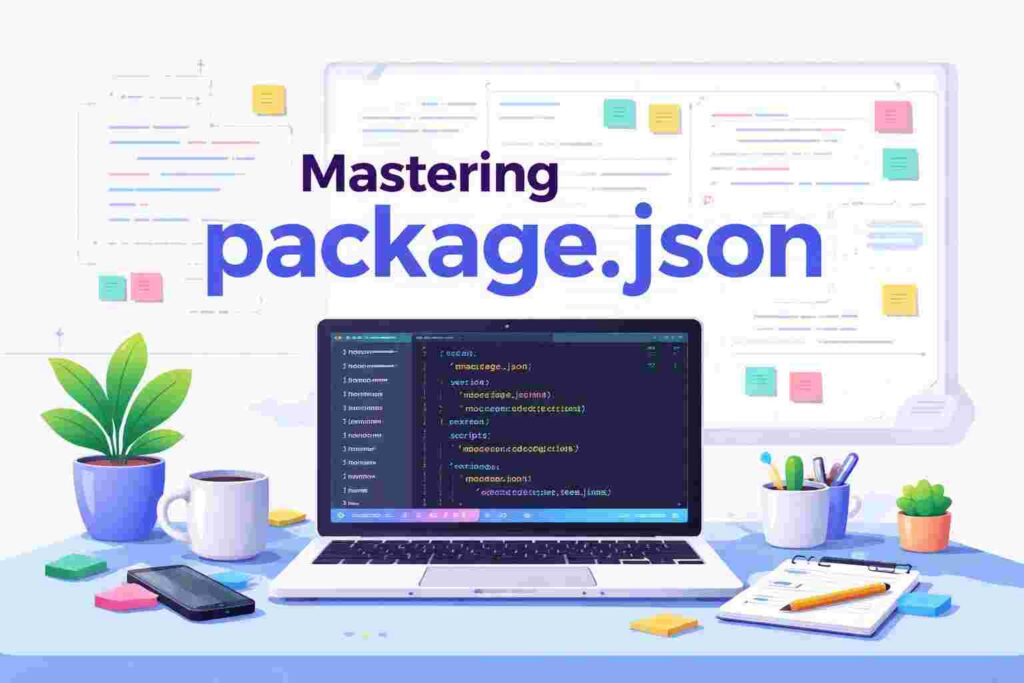
In the world of modern JavaScript development, package.json is the backbone of every Node.js project. Whether you’re building a small utility script or a large-scale production application, understanding package.json is critical. It defines your project’s identity, dependencies, scripts, configurations, and much more.
Table of Contents
According to the 2023 Stack Overflow Developer Survey, Node.js remains one of the most widely used web technologies, with over 42% of developers actively using it. At the center of nearly every Node.js project lies a properly configured package.json file.
But here’s the problem: many developers use it daily without fully understanding its power.
This guide breaks down the 7 powerful basics every Node.js developer should know about package.json — clearly, professionally, and practically.
What Is package.json and Why It Matters
At its core, package.json is a metadata file written in JSON format that sits in the root of a Node.js project. It serves as the configuration hub for your application.
When you run:
npm init
Node generates a package.json file that defines:
- Project name
- Version
- Description
- Entry point
- Scripts
- Dependencies
- Author and license
Without package.json, dependency management becomes chaotic. It ensures reproducibility. Anyone cloning your repository can install the exact required packages using:
npm install
That consistency is critical in collaborative environments.
The Role of package.json in Modern JavaScript Ecosystems
Beyond simple configuration, package.json plays a central role in the modern JavaScript ecosystem. It acts as a contract between your application and the Node.js runtime. Every tool in the ecosystem—npm, Yarn, pnpm, bundlers, CI/CD systems, deployment pipelines—reads and interprets package.json.
For example, build tools like Webpack and Vite rely on dependency declarations to bundle assets correctly. Continuous Integration services inspect scripts and engine requirements to ensure compatibility. Hosting platforms like Vercel or Netlify analyze the file to determine build commands automatically.
This centralized configuration reduces human error and makes projects portable. A properly structured package.json ensures:
- Predictable builds
- Reproducible environments
- Easier onboarding for new developers
- Reduced configuration duplication
- Clear dependency transparency
In professional environments, package.json is not optional—it is infrastructure.
1. Project Metadata: Name, Version, and Description
The first section of package.json defines your project’s identity.
Key Metadata Fields:
- name – Unique project name
- version – Semantic versioning (e.g., 1.0.0)
- description – Short explanation of the project
- author
- license
Why Versioning Matters
Node.js uses semantic versioning (SemVer):
| Segment | Meaning |
|---|---|
| MAJOR | Breaking changes |
| MINOR | Backward-compatible features |
| PATCH | Bug fixes |
For example:
"version": "2.1.4"
This indicates:
- Major version 2
- Minor update 1
- Patch 4
Proper versioning prevents deployment conflicts and improves maintainability.
2. Dependencies and DevDependencies
One of the most powerful features of package.json is dependency management.
Types of Dependencies
- dependencies – Required for production
- devDependencies – Used during development only
Example:
"dependencies": {
  "express": "^4.18.2"
},
"devDependencies": {
  "nodemon": "^3.0.0"
}
Why This Separation Matters
Separating production and development dependencies:
- Reduces production bundle size
- Improves performance
- Enhances security
- Simplifies deployment
According to npm statistics, the average JavaScript project includes over 80 dependencies. Proper management is essential to avoid security vulnerabilities and bloat.
Understanding Peer Dependencies and Optional Dependencies
In addition to dependencies and devDependencies, package.json also supports:
- peerDependencies
- optionalDependencies
Peer Dependencies
Peer dependencies are used when a package expects the host project to provide a specific dependency version.
Example:
"peerDependencies": {
  "react": "^18.0.0"
}
This ensures compatibility without bundling duplicate versions.
Peer dependencies are especially important in plugin development and shared libraries.
Optional Dependencies
Optional dependencies are installed only if the environment supports them.
Example:
"optionalDependencies": {
  "fsevents": "^2.3.2"
}
If installation fails, npm does not break the entire process.
This flexibility helps cross-platform compatibility, especially between Windows, macOS, and Linux systems.
Understanding these advanced dependency types gives developers greater control over package behavior.
3. Scripts Section: Automating Your Workflow
The “scripts” field allows you to define custom commands.
Example:
"scripts": {
  "start": "node index.js",
  "dev": "nodemon index.js",
  "test": "jest"
}
You can run these commands using:
npm run dev
Common Script Uses:
- Starting development server
- Running tests
- Building production assets
- Linting code
- Formatting files
Automation improves productivity and ensures consistency across teams.
Advanced Script Chaining and Lifecycle Hooks
Scripts in package.json are not limited to simple commands. You can chain commands using logical operators.
Example:
"scripts": {
  "build": "npm run lint && npm run test && npm run compile"
}
This ensures that code quality checks pass before compilation.
Additionally, npm supports lifecycle hooks such as:
- preinstall
- postinstall
- prestart
- poststart
Example:
"scripts": {
  "prestart": "npm run build"
}
This automatically runs the build process before starting the application.
In large-scale applications, these automation capabilities significantly reduce human intervention and deployment errors.
4. Entry Point and Main Configuration
The "main" field specifies the entry file of your application.
Example:
"main": "app.js"
If someone installs your package, Node looks at this file as the default entry.
For library developers, this becomes critical when publishing to npm.
Additional Config Fields
- type – CommonJS or ES module
- engines – Node version compatibility
Example:
"type": "module",
"engines": {
  "node": ">=18"
}
This prevents runtime incompatibility issues.
5. Version Ranges and Caret (^) Behavior
Dependency versions can be flexible.
Example:
"express": "^4.18.2"
The caret symbol (^) means:
- Accept minor updates
- Reject major breaking changes
Other symbols include:
| Symbol | Meaning |
|---|---|
| ^ | Compatible minor updates |
| ~ | Patch updates only |
| * | Any version |
Improper version control can break production systems unexpectedly.
6. package-lock.json Relationship
While package.json defines dependency ranges, package-lock.json locks exact versions.
Why is this important?
- Ensures identical installations
- Prevents environment discrepancies
- Enhances CI/CD reliability
Without lock files, builds may vary across machines.
Why Lock Files Improve Deployment Stability
Imagine two developers installing the same project on different days. If dependency ranges allow flexible updates, they may receive different package versions. That can introduce unexpected bugs.
package-lock.json prevents this by locking exact resolved versions.
Benefits include:
- Stable CI/CD pipelines
- Identical production builds
- Fewer “works on my machine” issues
- Controlled upgrade strategy
In enterprise environments, reproducibility is non-negotiable. Lock files ensure consistency across development, staging, and production.
7. Publishing and Distribution
If you’re building a reusable library, package.json enables publishing to npm.
Before publishing, ensure:
- Proper name
- Valid version
- Description
- Keywords
- Repository link
According to npm’s official data (npmjs.com), over 2 million packages are hosted publicly. Proper configuration increases discoverability.
Comparison Table: Key Sections of package.json
| Section | Purpose | Required | Affects Production |
|---|---|---|---|
| name | Identifies package | Yes | Yes |
| version | Version tracking | Yes | Yes |
| dependencies | Production packages | Yes | Yes |
| devDependencies | Development tools | No | No |
| scripts | Automation | No | Indirect |
| main | Entry file | Yes (for packages) | Yes |
| engines | Compatibility | No | Yes |
Common Mistakes Developers Make
Even experienced developers misuse package.json.
Top Errors:
- Using “*” for dependency versions
- Mixing dev and production dependencies
- Ignoring semantic versioning
- Forgetting lock file commits
- Not specifying Node engine version
These mistakes often lead to deployment instability.
Security Considerations in package.json
Security vulnerabilities often stem from outdated dependencies.
Best practices:
- Run
npm audit - Update regularly
- Avoid abandoned packages
- Use trusted libraries
- Monitor dependency tree
The Node ecosystem evolves rapidly. Staying updated reduces exposure.
Managing Supply Chain Risks in Node.js
The JavaScript ecosystem contains millions of open-source packages. While this enables rapid development, it also introduces supply chain risk.
In recent years, several high-profile attacks involved malicious packages published to npm. Attackers injected harmful code into dependencies that automatically installed via package.json.
To reduce risk:
- Pin critical dependency versions
- Audit dependencies frequently
- Avoid unmaintained libraries
- Use tools like npm audit or Snyk
- Review dependency trees regularly
According to industry security reports, over 80% of modern applications rely on open-source dependencies. This makes proactive dependency management essential.
Security is no longer optional—it is part of responsible software engineering.
FAQs About package.json
1. Is package.json mandatory for Node.js projects?
Technically no, but practically yes. It is essential for dependency management and project configuration.
2. What happens if package.json is missing?
npm cannot install dependencies automatically. Manual management becomes difficult.
3. Can I manually edit package.json?
Yes. It is simply a JSON file. However, syntax errors can break installations.
4. What is the difference between dependencies and devDependencies?
dependencies are required in production; devDependencies are only needed during development.
5. Should package-lock.json be committed?
Yes. It ensures consistent installations across environments.
6. Can I have multiple scripts?
Yes. You can define unlimited custom scripts under the “scripts” field.
Best Practices for Maintaining package.json
Maintaining a clean and well-structured package.json file improves project longevity.
Recommended Practices:
- Keep dependencies updated regularly
- Remove unused packages
- Use exact version control for critical systems
- Define clear scripts for team workflows
- Document project configuration
Periodic review prevents technical debt from accumulating.
A disciplined approach ensures that your package.json remains a reliable foundation rather than a cluttered configuration file.
Conclusion
Understanding package.json is fundamental for every Node.js developer. It is not just a configuration file — it is the operational blueprint of your application.
From managing dependencies to defining scripts and controlling versioning, mastering package.json improves project stability, collaboration, and scalability.
If you’re serious about professional Node.js development, start treating your package.json file as a strategic asset — not just boilerplate.