In an era characterized by rapid technological evolution, multi-agent communication stands as a linchpin for complex systems. As we delve into this multifaceted topic, it becomes apparent that understanding its nuances is integral to harnessing the full potential of technologies reliant on cooperative agents. This article aims to dissect the fundamentals, mechanisms, and implications of multi-agent communication, alongside its future trajectory across various industries.
Fundamentals of Multi-Agent Systems
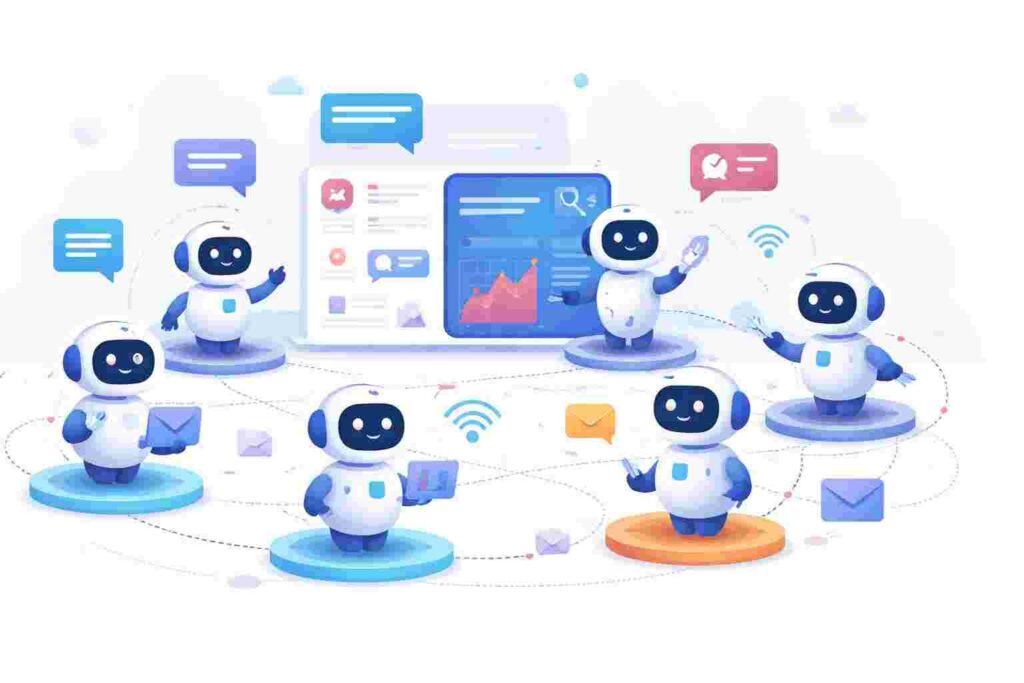
A multi-agent system (MAS) comprises multiple interacting intelligent agents, capable of independent or joint actions in pursuit of specific goals. These systems provide a framework for problem-solving and decision-making, particularly when the challenges are beyond the capabilities of a single agent.
Definition of Multi-Agent Systems
Multi-agent systems are defined by their ability to coordinate and cooperate through direct or indirect communication. Agents in these systems often possess unique capabilities, allowing for specialization and efficiency.
Types of Agents
- Reactive Agents: These agents respond to stimuli from their environment without internal cognitive processes.
- Deliberative Agents: These agents use planning to achieve goals based on their knowledge of the environment.
- Hybrid Agents: This type combines characteristics of both reactive and deliberative agents.
- Learning Agents: Agents that improve their performance based on experiences or past interactions.
- Mobile Agents: These can move from one environment to another, executing tasks autonomously.
Roles of Communication
Communication is the backbone of a multi-agent system, enabling agents to share knowledge, coordinate actions, and negotiate solutions. The effectiveness of this communication directly influences the system’s performance.
Communication Mechanisms in Multi-Agent Systems
The communication in multi-agent systems can take various forms, often influenced by the system’s architecture and the specific protocols employed.
Message Passing Techniques
Message passing involves agents sending and receiving information to achieve task completion. Techniques include asynchronous messaging, synchronous messaging, and broadcasting.
Protocols for Communication
- Agent Communication Language (ACL): A standard for agent communication facilitating interoperability among diverse systems.
- FIPA Standards: Established protocols that enhance agent communication through defined interaction patterns.
- HTTP/RESTful Services: Methods used for web-based agent interactions, ensuring accessibility and integration.
- SOAP Protocol: Involves structured exchanges for web services, enhancing complex inter-agent communications.
- RMI (Remote Method Invocation): Allows agents to invoke methods of remote objects, crucial for distributed systems.
Data Exchange Formats
Data formats play a crucial role in the efficiency and effectiveness of communications. Common formats include:
- XML (eXtensible Markup Language): Used for data representation and exchange due to its structured nature.
- JSON (JavaScript Object Notation): A lightweight format favored for its simplicity and ease of use in web-based applications.
- CSV (Comma-Separated Values): Employed for transferring tabular data between agents.
- Protocol Buffers: A method developed by Google for serializing structured data.
- RDF (Resource Description Framework): Ideal for semantic data applications within multi-agent systems.
Frameworks and Architectures for Multi-Agent Communication
Various frameworks and architectural designs enable the development and implementation of multi-agent systems, each serving distinct purposes and advantages.
Centralized vs. Decentralized Architectures
Centralized systems rely on a single point of control, enhancing coordination but possibly creating bottlenecks. Conversely, decentralized architectures allow individual agents greater autonomy, reducing single points of failure but complicating coordination efforts.
Popular Frameworks (e.g., JADE, SPADE)
- JADE (Java Agent DEvelopment Framework): Facilitates development of multi-agent systems in Java, supporting FIPA-compliant protocols.
- SPADE (Intelligent Multi-Agent System): Offers a flexible environment for building collaborative agent systems using Python.
- CONFIG: An agent-based simulation framework focusing on agent interactions and environment behavior.
- MadKit: An open-source platform designed to foster collaborative multi-agent systems.
- AgentBuilder: A visual programming environment for rapid deployment of multi-agent solutions.
Design Patterns for Communication
Adopting design patterns helps streamline communication within multi-agent systems. Common patterns include:
- Observer Pattern: Useful for implementing publish-subscribe systems where agents can observe and respond to changes.
- Strategy Pattern: Allows agents to select communication strategies dynamically based on context.
- Command Pattern: Encapsulates requests as objects, supporting queueing and logging of communication.
- Mediator Pattern: Centralizes communication to reduce the complexity of interactions among agents.
- Factory Pattern: Facilitates the creation of agents depending on the specific context and requirements.
Industry Applications and Impact
Multi-agent communication has far-reaching implications across diverse sectors, reshaping processes and outcomes significantly.
Healthcare Applications
In the healthcare sector, multi-agent systems enable interoperability among medical devices, ensuring efficient data transfer and real-time patient monitoring.
- Improved patient data management.
- Enhanced telemedicine solutions.
- Automation of administrative tasks.
- Facilitation of personalized medicine approaches based on data collected from various agents.
- Real-time analysis for emergency response systems.
Manufacturing and Robotics
The integration of multi-agent communication within manufacturing leads to streamlined workflows and enhanced productivity.
- Collaborative robots (cobots) working seamlessly alongside human workers.
- Real-time monitoring for maintenance and supply chain optimization.
- Automated quality control through intelligent agents.
- Adaptive systems that adjust to market demands.
- Usage of digital twins for simulating processes before implementation.
Smart Grid and Energy Management
Smart grids utilize multi-agent systems for efficient energy distribution and management, facilitating real-time data exchange.
- Demand response management to optimize energy use.
- Integration of renewable energy sources.
- Decentralized energy trading among users.
- Real-time grid health monitoring.
- Proactive fault detection to enhance grid reliability.
Finance and Trading Systems
In financial markets, multi-agent systems enhance trading strategies through automated interactions among agents.
- Development of algorithms for high-frequency trading.
- Risk assessment using agent-based simulations.
- Enhancement of customer service through intelligent chatbots.
- Fraud detection systems powered by collaborative algorithms.
- Portfolio management leveraging historical performance data.
Strategic Advantages of Multi-Agent Communication
Implementing multi-agent communication provides organizations with several competitive advantages, enhancing both performance and functionality.
Scalability
Multi-agent systems can scale effortlessly by adding new agents to address increasing demands without fundamentally altering the system’s architecture.
Flexibility
These systems adapt quickly to changing environments, allowing organizations to respond proactively to market shifts or operational challenges.
Efficiency and Cost-Reduction
- Optimized resource allocation by informing agents of supply and demand realities.
- Reduction of human error through automated processes.
- Enhanced collaboration yields fewer operational bottlenecks.
- Lower operational costs due to increased efficiency.
- Improved overall productivity and profitability.
Challenges and Limitations of Multi-Agent Communication
Despite the advantages, multi-agent communication also presents challenges that organizations must confront in their implementation journeys.
Complexity in Coordination
As the number of agents increases, so too does the complexity of coordination and management. This can lead to challenges in ensuring seamless interoperability among agents.
Security and Privacy Concerns
- Increased vulnerability to cyber-attacks due to the interconnected nature of agents.
- Challenges in maintaining data integrity across distributed systems.
- Privacy issues surrounding the handling of sensitive information among agents.
- Need for robust security protocols to safeguard interactions.
- Management of identification and authorization mechanisms for agents.
Resource Management Issues
Resource allocation becomes tricky as the system scales, necessitating intelligent mechanisms to distribute tasks and maintain equilibrium.
Comparative Analysis of Multi-Agent Communication Models
Evaluating different multi-agent models reveals their respective advantages and trade-offs, providing insight into optimal application scenarios.
Distributed vs. Centralized Models
Distributed models offer autonomy to agents and are often more resilient to failures, but centralized models provide simplicity in management.
Reactive vs. Deliberative Agents
Reactive agents are faster but less adaptable, whereas deliberative agents take longer to act due to their planning processes.
Comparison Table of Models
| Model Type | Pros | Cons |
|---|---|---|
| Centralized | Easy management, quick decision-making | Single point of failure, limited scalability |
| Distributed | Resilient, scalable, autonomous decision-making | Complex coordination, higher resource consumption |
| Reactive | Fast response times, low computational overhead | Limited adaptability, not suitable for complex tasks |
| Deliberative | High flexibility, strategic planning capabilities | Slower response times, more resource-intensive |
Statistics and Market Trends
Understanding current statistics and trends surrounding multi-agent systems is vital for grasping their growing impact across various industries.
Market Growth Projections
The global multi-agent systems market is projected to grow from $700 million in 2022 to approximately $2 billion by 2028, demonstrating a compound annual growth rate (CAGR) of over 20%.
Investment Trends
- Increased funding in AI-driven multi-agent systems, with over $5 billion invested in 2021 alone.
- Growth in academic research focusing on agent-based simulations.
- Emergence of startups specializing in multi-agent solutions for specific industries.
- Government initiatives to boost the development of intelligent systems.
- Collaborations between tech giants to create advanced multi-agent applications.
Adoption Rates in Industries
Adoption of multi-agent systems varies across industries, with finance and healthcare leading the way due to their need for automation and efficiency. Reports indicate that approximately 60% of firms within these sectors are currently utilizing agent-based technologies.
Real-World Case Studies in Multi-Agent Communication
Real-world implementations provide valuable insights into the practical benefits of multi-agent communication.
Case Study in Healthcare
In a prominent hospital, implementing multi-agent systems improved patient data retrieval times by 40%, leading to faster diagnosis and treatment administration.
Case Study in Autonomous Vehicles
A fleet of autonomous delivery drones utilized multi-agent communication, allowing for dynamic route adjustments and reducing delivery times by 50%.
Case Study in Smart Manufacturing
By employing multi-agent communication, a manufacturing company reduced production defects by 35%, significantly enhancing overall efficiency and cost-effectiveness.
Future Outlook of Multi-Agent Communication
As technology advances, the future of multi-agent communication seems promising, with numerous possibilities on the horizon.
Emerging Technologies
The integration of 5G and IoT will likely facilitate improved real-time communication among agents, making them more responsive and efficient.
Potential Research Directions
- Developing more adaptive and robust communication protocols.
- Exploring the implications of combining swarm intelligence with multi-agent systems.
- Investigating the ethical considerations related to autonomous agents.
- Enhancing interoperability standards for diverse multi-agent systems.
- Integrating cognitive computing principles for improved decision-making.
Long-Term Industry Impacts
Long-term adoption of multi-agent communication can lead to transformative changes in operational efficiency, innovation acceleration, and enhanced customer experiences across industries.
Frequently Asked Questions
What are multi-agent systems?
Multi-agent systems are computational systems that consist of multiple entities known as agents. Each agent operates independently or collaboratively to achieve designated objectives. These systems can be used in a variety of domains, amplifying efficiency and responsiveness to challenges.
How do agents communicate?
Agents communicate using predefined protocols and languages, such as Agent Communication Language (ACL) or through data formats like JSON. This communication can be synchronous or asynchronous, depending on the system design and requirements.
What industries benefit from multi-agent systems?
Various industries reap the advantages of multi-agent systems, notably healthcare, finance, smart grid, and manufacturing. Each sector leverages these systems to enhance functionality, automate processes, and promote collaboration.
What are the limitations of multi-agent systems?
Limitations include challenges in coordination as the number of agents increases, potential security and privacy issues due to interconnectedness, and the complexities related to resource management. Addressing these challenges requires strategic planning and implementation.
How is security managed in these systems?
Security in multi-agent systems involves implementing robust authentication and authorization protocols, encryption for communication, and regular audits to assess vulnerabilities. Additionally, employing established standards can mitigate risks associated with agent interactions.
What trends are shaping the future of multi-agent communication?
Current trends include the rise of AI integration, the growing importance of IoT connectivity, and advancements in communication technology such as 5G. These factors will likely enhance the capabilities of multi-agent systems, making them more adaptive and influential in various sectors.
Conclusion
In conclusion, the significance of multi-agent communication in today’s technology landscape cannot be overstated. As we have explored throughout this article, its applications span various industries, yielding substantial improvements in efficiency, communication, and operational effectiveness. As we move forward, the continued evolution of these systems will undoubtedly shape the future of technology and business alike. Understanding and leveraging multi-agent communication will be essential for organizations aiming to navigate the complexities of the digital age.