
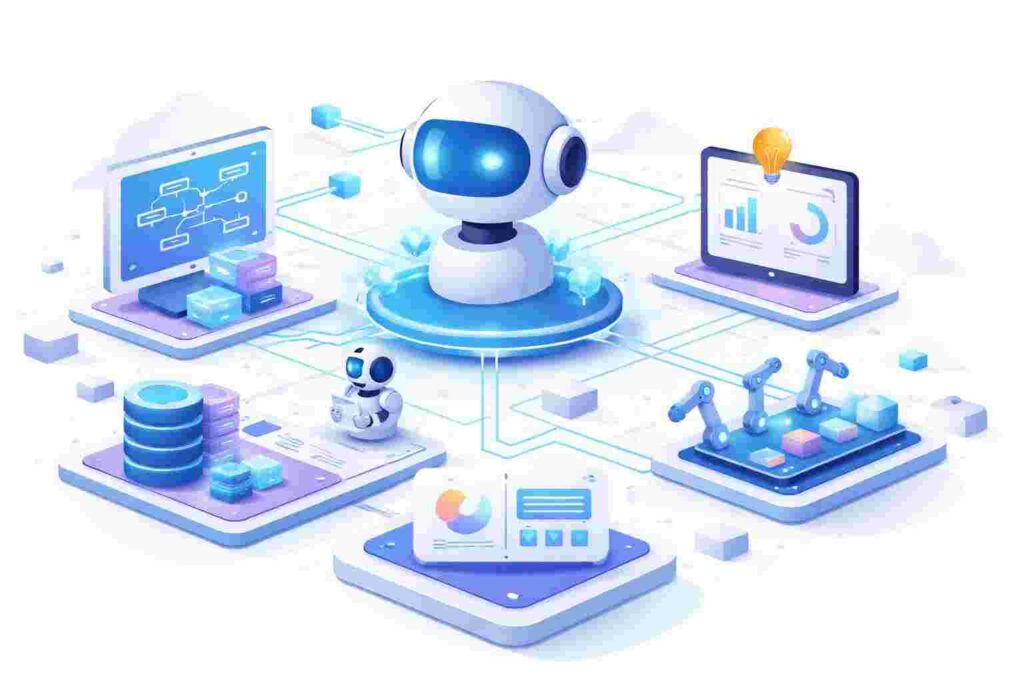
In the rapidly evolving landscape of artificial intelligence, the BabyAGI architecture stands out as a transformative approach that merges advanced concepts from machine learning, cognitive science, and computational theories. This architecture is not only significant in AI development but also has far-reaching implications across various industries. This article delves deep into the foundational elements, technical mechanisms, business impacts, and future outlook of BabyAGI architecture, providing insights into its profound potential.
Understanding the Foundations of BabyAGI
To appreciate the full impact of BabyAGI architecture, it’s essential to first understand its foundational elements. This section will cover the core principles, the historical context, and the essential components that make up the framework.
Core Principles of AGI
- Generalization: The ability to apply learned skills across different contexts.
- Autonomy: Performing tasks independently without human intervention.
- Learning: Continuous improvement through experience and adaptation.
- Interaction: Effective communication and collaboration with humans and other AI.
Historical Context of BabyAGI
The journey to BabyAGI originates from decades of research in AI and cognitive systems, with significant milestones that include developments in neural networks, natural language processing, and machine learning. Early models like symbolic AI laid the groundwork, but it was the emergence of deep learning that catalyzed advancements toward AGI, making architectures like BabyAGI possible.
Essential Components of the Architecture
- Neural Networks: Fundamental to processing information and learning from data.
- Data Pipelines: Systems that facilitate the gathering and preparation of large data sets.
- Feedback Mechanisms: Allowing continuous learning and adaptation.
- Ethical Frameworks: Ensuring the responsible use of AI technology.
Technical Mechanisms Behind BabyAGI
This section will explore the intricate workings of BabyAGI. Understanding how it operates requires delving into its algorithms, data processing techniques, and training protocols.
Neural Network Structures
At the heart of BabyAGI are complex neural networks that mimic human brain functionalities. These networks use layers of interconnected nodes to process information. Innovations like convolutional neural networks (CNNs) for image recognition and recurrent neural networks (RNNs) for sequence data play crucial roles.
Data Processing Techniques
- Data Augmentation: Techniques to expand training data sets for robust learning.
- Feature Extraction: Identifying and selecting key characteristics from raw data.
- Normalization: Adjusting data for consistent scaling and performance.
- Batch Processing: Efficiently processing data in groups to optimize learning speed.
Training Protocols and Optimization
The training of BabyAGI systems involves various optimization algorithms like Adam and RMSprop, which enhance the speed and effectiveness of learning. Hyperparameter tuning is also essential to ensure optimal performance, allowing models to adapt to different tasks effectively.
Business Impact of BabyAGI Across Industries
The introduction of BabyAGI technology is not merely a technological advancement; it is poised to revolutionize business operations across various sectors. Let’s examine its impact in key industries:
Transforming Healthcare Delivery
- Predictive Analytics: Enhancing patient outcomes through data-driven insights.
- Personalized Medicine: Tailoring treatments to individual patient profiles.
- Operational Efficiency: Streamlining administrative tasks to reduce costs.
- Telemedicine: Facilitating remote care through AI-driven solutions.
Revolutionizing Financial Analysis
In finance, BabyAGI facilitates improved decision-making through deep learning algorithms that identify patterns in financial markets, assess risk, and enhance portfolio management strategies.
Enhancing Educational Technologies
- Adaptive Learning: Customizing educational experiences for each student.
- Automated Assessment: Assessing student performance in real-time.
- Resource Optimization: Allocating resources effectively based on data insights.
- Engagement Tools: Fostering interactive environments that enhance learning.
Strategic Advantages of Implementing BabyAGI
Integrating BabyAGI features into business strategies offers competitive advantages that can significantly impact an organization’s success. Below are the strategic benefits:
Increased Efficiency and Productivity
- Automation of Routine Tasks: Minimizing human error and freeing up employee time.
- Optimized Processes: Streamlining operations to enhance productivity.
- Data-Driven Insights: Leveraging AI to make informed strategic decisions.
- Resource Allocation: Ensuring that resources are used in the most effective areas.
Improved Decision Making
With BabyAGI, businesses can harness data analytics to make predictions and strategic decisions based on real-time insights.
Enhanced Customer Experiences
- Personalized Recommendations: Tailoring products and services to customer preferences.
- 24/7 Availability: Providing round-the-clock customer support through AI.
- Feedback Analysis: Understanding customer sentiment through automated analysis.
- Loyalty Programs: Designing initiatives to enhance customer retention.
Limitations and Risks of BabyAGI Technology
While the progression of BabyAGI offers numerous benefits, it also introduces several challenges and risks that must be addressed. Recognizing these is crucial for ethical implementations.
Ethical Concerns in AI Deployment
- Data Privacy: Protection of sensitive information from misuse.
- Bias in AI Models: Ensuring fair outcomes irrespective of demographics.
- Transparency: Understanding AI decision-making processes.
- Impact on Employment: Navigating workforce displacement due to automation.
Security Vulnerabilities
As AI systems become more complex, they also become attractive targets for malicious actors. Organizations must implement robust cybersecurity measures to protect their BabyAGI systems from breaches.
Regulatory Compliance Issues
- Adherence to Standards: Ensuring compliance with local and international regulations.
- Dynamic Regulations: Keeping up with evolving laws surrounding AI use.
- Audit Trails: Maintaining records for system operations and decision-making.
- Ethical Guidelines: Creating protocols for responsible AI development.
Comparison and Evaluation of BabyAGI with Traditional AI
To fully understand the transformative nature of BabyAGI, it is useful to compare it against traditional AI frameworks. The following table outlines key differences.
| Aspect | BabyAGI | Traditional AI |
|---|---|---|
| Learning Methodology | Adaptive learning through experience and feedback | Rule-based learning with limited adaptation |
| Scalability | Easily scalable across various applications and tasks | Less adaptable and harder to scale |
| Complexity | Handles more complex tasks and interactions | Usually predefined and simpler |
| Execution Speed | Real-time decision-making capabilities | Slower due to batch processing and less integration |
Statistics and Market Trends in BabyAGI Adoption
The growth of BabyAGI is not just a prediction but a measurable trend backed by data. Recent statistics indicate a substantial increase in adoption rates in key sectors.
Growth Rate of AI in Various Sectors
- Healthcare AI is projected to grow at a CAGR of 41.7% from 2021 to 2028.
- The educational technology sector is expected to reach $404 billion by 2025, driven by AI integration.
- Financial services employing AI are estimated to save $1 trillion by 2030.
- Consumer AI applications are predicted to increase user engagement by 87% in the next five years.
Investment Trends in BabyAGI Development
Investments in AI-driven technologies, especially BabyAGI, have surged, with venture capital funding dedicated to AI startups reaching unprecedented levels. According to a report by McKinsey, more than $24 billion was invested into AI technologies in the last year alone.
User Adoption Statistics
- 62% of businesses report increased efficiency after implementing AI solutions.
- 78% of users are more likely to use services powered by AI technologies.
- 54% of executives believe AI will have a significant impact on their business within three years.
- Over 40% of organizations are now in the process of implementing AI technologies.
Real-World Case Studies of BabyAGI Implementation
To illustrate the practical applications of BabyAGI, this section highlights case studies that exhibit its power and effectiveness across diverse scenarios.
Case Study in Healthcare Efficiency
One hospital implemented BabyAGI in their patient management system, achieving a 30% reduction in patient wait times and a 25% increase in patient satisfaction ratings.
Case Study in Financial Risk Management
A financial institution utilized BabyAGI for loan risk assessment, decreasing loan default rates by 15% while increasing processing speed by 40%.
Case Study in Personalized Learning
An educational platform adopted BabyAGI to create customized learning paths for students, resulting in a 50% improvement in student grades.
Future Outlook of BabyAGI Technology
As we look ahead, the advancements in BabyAGI technology promise to reshape our world significantly. The anticipation of new integrations across industries brings both excitement and caution.
Projections for Market Growth
Analysts predict that the BabyAGI market will grow exponentially, with estimations indicating it could surpass $300 billion by 2030. This growth is driven by the increasing demand for smarter technology to solve complex problems.
Emerging Technologies in AGI
- Quantum Computing: Enhancing processing power and efficiency.
- Neuromorphic Computing: Mimicking brain functionalities for improved AI operations.
- Blockchain: Ensuring transparency and security in AI systems.
- 5G Technology: Enabling real-time communication and data transfer for AI applications.
Long-term Societal Implications
The shift towards BabyAGI will likely redefine jobs, improve social services, and foster innovative solutions to global challenges, such as climate change and healthcare accessibility.
Frequently Asked Questions about BabyAGI
This section addresses the most common inquiries regarding BabyAGI architecture and its applications.
What is BabyAGI?
BabyAGI refers to a novel approach to artificial general intelligence, aiming to emulate human cognitive processes. This architecture focuses on independence, learning, and adaptability, distinguishing itself from traditional AI systems.
How does BabyAGI differ from traditional AI?
Unlike traditional AI, which typically operates within narrow parameters and predefined rules, BabyAGI possesses the capability to learn dynamically, adapt to new information, and make autonomous decisions. This results in applications that are more sophisticated and humane in interaction.
What industries can benefit from BabyAGI?
Numerous sectors can harness BabyAGI’s capabilities, including healthcare for patient management, finance for risk assessment, education for personalized learning experiences, and manufacturing for process optimization.
What are the risks associated with BabyAGI?
While BabyAGI presents unique opportunities, it also poses risks such as ethical concerns about data use, potential biases in decision-making processes, and the necessity for robust security mechanisms to prevent misuse.
How is BabyAGI being regulated?
The regulatory landscape for AI is continually evolving. Current regulations often focus on data privacy and ethical use, and organizations must stay abreast of these changes to ensure compliant implementation of BabyAGI systems.
What is the future potential of BabyAGI?
The future of BabyAGI is filled with potential, particularly as more sectors embrace its capabilities. From enhancing customer experiences to optimizing operational efficiencies, BabyAGI is set to become a cornerstone of innovation in technology.
Conclusion and Key Takeaways
In summary, understanding the BabyAGI architecture is essential for those navigating the future of artificial intelligence. As this technology advances, continuous research and development will drive its capabilities further.
Recap of BabyAGI Architecture
BabyAGI represents a paradigm shift in AI design, emphasizing autonomy, flexibility, and intelligence that closely resembles human processes.
Importance of Continued Research
Ongoing research is critical to addressing the challenges and ensuring that developments in BabyAGI are ethical, secure, and beneficial for society.
Call to Action for Industry Leaders
Industry leaders must prioritize the integration of BabyAGI within their strategies to remain competitive, ensuring they are prepared to innovate in a rapidly changing landscape.