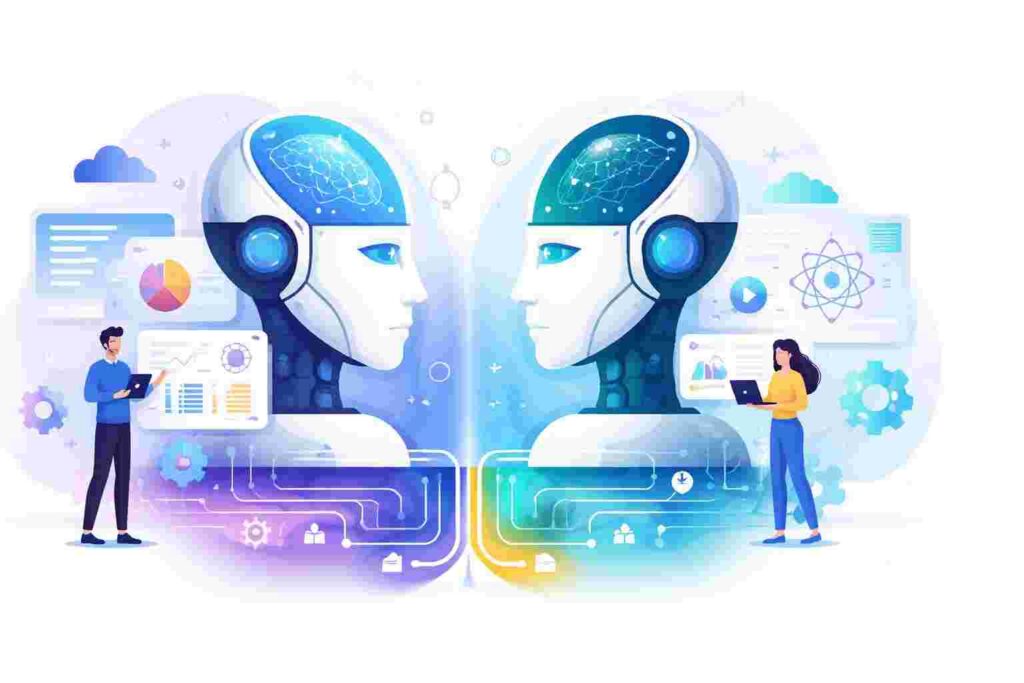
As we venture deeper into the 21st century, the landscape of artificial intelligence continues to evolve at an unprecedented pace. Among the notable advancements, two influential paradigms have emerged: Agentic AI vs Generative AI Guide. Each of these systems brings unique capabilities, use cases, and implications for technology, business, and society at large. In this comprehensive analysis, we will explore what defines Agentic AI vs Generative AI Guide, their operational mechanisms, applications across various sectors, and forecasts for their future impact. Understanding these two forms of artificial intelligence is crucial for organizations seeking to harness their potential effectively.
Table of Contents
Understanding Agentic AI
At its core, Agentic AI refers to systems that possess the ability to act autonomously and make decisions based on their learned experiences. This capability differentiates it significantly from traditional AI, which generally functions under strict human oversight or predefined rules.
Definition of Agentic AI
Agentic AI can be defined as a class of AI that is designed to execute tasks and make decisions independently, leveraging data and algorithms to optimize outcomes. This AI type is programmed to learn from interactions with its environment, continually improving its performance over time.
Key Features of Agentic AI
- Autonomous Decision-Making: Capable of making decisions without human intervention.
- Learning from Experience: Uses feedback loops to refine its strategies and actions.
- Task Adaptability: Able to perform varying tasks based on changing environments.
- Self-Optimization: Continuously improves performance metrics through learning.
Different Types of Agentic AI
Agentic AI can be categorized into several types, each with its specific applications:
- Autonomous Agents: Performs tasks in the absence of human oversight.
- Multi-Agent Systems: Involves multiple agents operating together to solve complex problems.
- Robotic Process Automation: Automates repetitive tasks and processes in business settings.
Understanding Generative AI
While Agentic AI focuses on decision-making, Generative AI emphasizes the creation of content, from text to images and beyond. By leveraging extensive datasets, it generates new outcomes that mimic the style or substance of the training data.
Definition of Generative AI
Generative AI refers to algorithms that create new content based on learned patterns from existing datasets. Unlike traditional AI that primarily classifies or analyzes data, Generative AI actively produces new outputs, making it an exciting domain for creativity and innovation.
Key Features of Generative AI
- Content Creation: Generates new media based on training data.
- Data Augmentation: Enhances datasets through the introduction of synthetic data.
- Adaptive Learning: Can adapt output to various styles or formats based on user input.
- Interdisciplinary Application: Utilizes techniques across various fields like art, music, and marketing.
Applications of Generative AI
Generative AI has a broad range of applications, some of which include:
- Creative Industries: Generating artwork, music, and literature.
- Marketing: Creating personalized content for campaigns.
- Product Design: Rapid prototyping of design and functionalities.
- Healthcare: Developing drug simulations and imaging techniques.
Technical Mechanisms of Agentic AI
To appreciate Agentic AI thoroughly, it is important to examine the technical foundations that enable its autonomous behaviors.
Algorithms Behind Agentic AI
Key algorithms that power Agentic AI include:
- Reinforcement Learning: Learns optimal actions through exploration and feedback.
- Decision Trees: Helps in decision-making based on predefined conditions.
- Markov Decision Processes: Provides a framework for modeling decision-making.
Data Requirements for Agentic AI
Agentic AI systems require extensive datasets to train effectively. Data must be relevant, diverse, and of high quality to ensure that the models learn adequately and operate successfully in real-world settings.
Performance Metrics for Agentic AI
To evaluate the performance of Agentic AI, several metrics are useful:
- Accuracy: Measures the correctness of actions taken.
- Response Time: Indicates how quickly the system can respond to an input or change.
- Learning Rate: Reflects how quickly the system improves its performance over time.
Technical Mechanisms of Generative AI
As with Agentic AI, understanding the technical components of Generative AI is vital for grasping how it operates.
Algorithms Behind Generative AI
Generative AI relies on sophisticated algorithms, primarily:
- Generative Adversarial Networks (GANs): Comprises two neural networks that compete to improve generation quality.
- Variational Autoencoders (VAEs): Utilizes probabilistic approaches to generate new data.
- Transformer Models: Employed for generating coherent text and sequence-based data.
Neural Networks in Generative AI
Neural networks play a crucial role in Generative AI by facilitating complex model architectures capable of understanding and creating multifaceted data structures.
Evaluation Metrics for Generative AI
Measuring the success of Generative AI can be tricky, yet several key metrics exist:
- Quality of Generated Content: Subjective measures based on user feedback or expert assessment.
- Diversity of Outputs: The range of different variations produced by the AI.
- Computational Efficiency: How effectively the model utilizes resources during operation.
Business Applications and Impact
The practical implications of Agentic AI vs Generative AI Guide are vast, touching upon various sectors and redefining how businesses operate.
Healthcare Applications
In healthcare, both AI types are making significant strides. Agentic AI can enhance decision-making in diagnostics, whereas Generative AI can facilitate drug discovery by simulating biological interactions.
Financial Services Applications
Financial institutions are leveraging Agentic AI to automate trading and risk assessment and Generative AI to generate personalized financial plans and marketing materials, allowing for more tailored customer experiences.
Marketing and Advertising Applications
Marketing sectors benefit significantly from Generative AI in crafting personalized ads automatically, while Agentic AI optimizes campaign performance through real-time data analysis.
Gaming and Entertainment Applications
In the gaming industry, Agentic AI creates more responsive and challenging adversaries, whereas Generative AI is key in developing unique gaming experiences and narrations dynamically.
Strategic Advantages of Agentic AI
Organizations can reap numerous advantages from the implementation of Agentic AI.
Decision-Making Capabilities
Agentic AI empowers organizations to automate crucial decision-making processes, thereby improving efficiency and accuracy. This autonomy significantly reduces human error and enhances decision reliability.
Customization and Flexibility
With its adaptive nature, Agentic AI enables businesses to tailor approaches and solutions to fit dynamic market conditions and individual customer needs.
Resource Optimization
Resources, including time and personnel, can be optimized using Agentic AI, allowing for enhanced productivity and cost savings across different operations.
Strategic Advantages of Generative AI
Generative AI offers unique benefits that can transform business strategies.
Content Creation Automation
By automating content generation, businesses can save time and ensure consistency. Content marketing can scale significantly through the use of Generative AI, allowing companies to create numerous materials quickly.
Enhanced Design and Prototyping
Generative AI accelerates design processes, providing dynamic prototypes that can be modified in real-time while incorporating feedback from stakeholders or users.
Rapid Prototyping and Testing
With its ability to quickly generate alternatives, Generative AI allows for faster iteration cycles in product development, thereby reducing time-to-market for innovations.
Limitations and Risk Considerations
Both Agentic and Generative AI are not without their challenges and ethical considerations.
Ethical Issues in Agentic AI
Agentic AI raises concerns related to autonomy and accountability. With systems making decisions independently, establishing who is responsible for mistakes or malfunctions becomes a pressing issue.
Risks Associated with Generative AI
Generative AI faces challenges like misinformation, as it can easily create realistic but false narratives or imagery. The potential for creative theft also poses significant risks in creative industries.
Regulatory Challenges for Both AI Types
The rapidly evolving AI landscape presents regulatory hurdles that lag behind technological advancements. Defining legal guidelines that encompass all aspects of AI deployment is crucial yet complex.
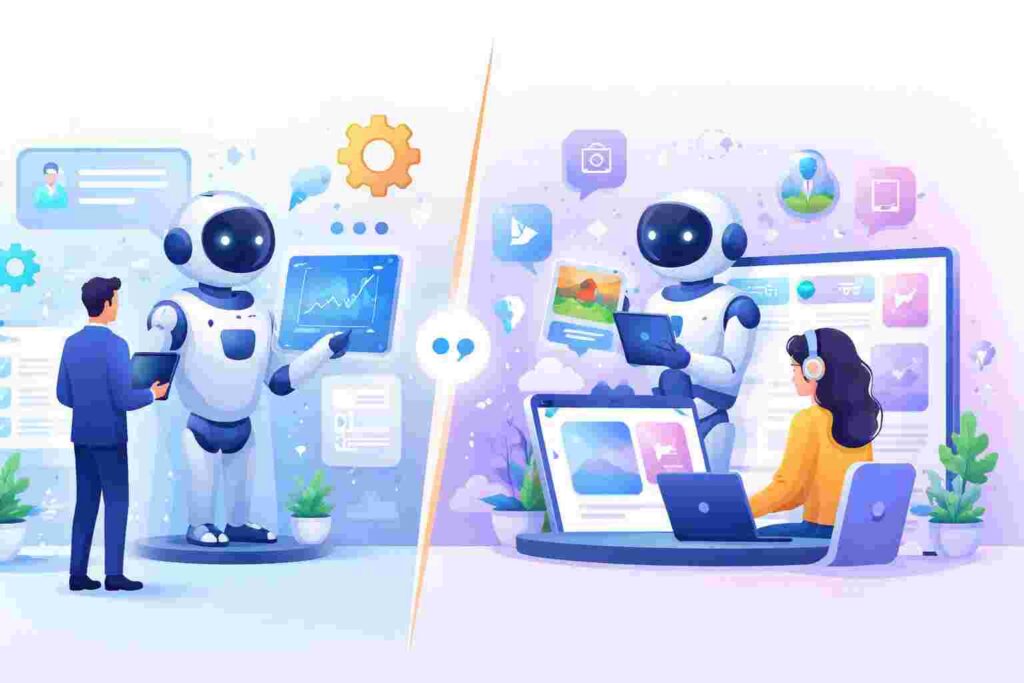
Comparing Agentic AI vs Generative AI Guide
To truly understand the differences between these two AI types, a detailed comparison is necessary.
Feature Comparison Table
| Feature | Agentic AI | Generative AI |
|---|---|---|
| Autonomy | High | Low |
| Focus | Decision Making | Content Creation |
| Applications | Healthcare, Finance | Marketing, Art |
| Learning Method | Reinforcement Learning | Generative Models |
| Output Type | Actions/Decisions | Text, Images, Music |
Performance Metrics Comparison
Performance metrics can significantly differ as well. For Agentic AI, metrics focus on decision accuracy and resource efficiency, while Generative AI metrics might prioritize creative quality and output diversity.
Industry Applications Comparison
Both AI types are applicable across different industries, yet their roles and impacts vary. Agentic AI tends to suit sectors requiring automation and real-time decision making, whereas Generative AI finds a niche in creative and design fields.
Statistics and Market Trends
As of 2023, the global AI market is estimated to reach approximately $500 billion, with a projected compound annual growth rate (CAGR) of 20.1% through 2026. Among this, the Generative AI segment is poised to grow rapidly, with expected revenues soaring to reach $70 billion by 2026.
Market Growth Projections
Market analysts expect that Agentic AI will also see significant investment, with forecasts showing a potential doubling of investment across industries over the next three years.
Adoption Rates by Industry
According to recent surveys, over 60% of surveyed businesses across sectors have reported adopting some form of AI technology, with media and healthcare leading in implementation rates.
Investment Trends in AI Technologies
Investment trends indicate a sharp upward trajectory for startups focused on AI development, specifically in creating autonomous systems and generative technologies, with venture capital firms increasingly funding innovative projects.
Real-World Case Studies
To illustrate the practical applications of these technologies, let’s review some case studies.
Case Study: Agentic AI in Healthcare
In 2022, a prominent healthcare provider integrated Agentic AI into their diagnostic processes, which resulted in diagnostic accuracy improvement by 30% within the first year of adoption.
Case Study: Generative AI in Marketing
One marketing firm implemented Generative AI for content creation, reducing content production time by 70% and significantly increasing their output volume, leading to a 40% rise in engagement rates.
Before and After Analysis of AI Impact
A comparative study of organizations pre- and post-AI implementation shows that productivity increased by 50% and operational costs decreased significantly, showcasing the clear benefits brought about by both Agentic and Generative AI.
Future Outlook for Agentic and Generative AI
The future holds exciting possibilities for both AI types, as they evolve to meet the changing demands of industries and consumers.
Upcoming Innovations
Advancements in natural language processing and machine learning are expected to continue driving improvements in both fields, leading to more sophisticated and user-friendly applications.
Future Industry Trends
Emerging trends indicate a greater convergence of Agentic and Generative AI, where systems will not only make independent decisions but also craft personalized experiences based on those decisions.
Societal Impacts of AI Advancements
As the reliance on AI grows, societal aspects such as job displacement, ethical use, and regulatory compliance will need to be addressed by industries and governments alike, ensuring a responsible approach to AI development.
Frequently Asked Questions
What are the main differences between Agentic and Generative AI?
The primary difference lies in their focus; Agentic AI centers around autonomous decision-making, whereas Generative AI is primarily concerned with creating new content. The former is more action-oriented, while the latter emphasizes creativity and generation.
How can businesses implement these AI technologies?
Businesses should start by defining their goals and identifying areas where AI can provide the most value. This often involves choosing the right technology partner, investing in the necessary infrastructure, and training staff to harness AI effectively.
What industries benefit the most from Agentic AI?
Industries such as healthcare, finance, and logistics are seeing significant benefits from Agentic AI. These sectors often involve complex decision-making processes where the technology can enhance efficiency and accuracy.
Are there any successful examples of Generative AI?
Yes, numerous companies have successfully integrated Generative AI in marketing campaigns, creating personalized ads that resonate with consumers. Another example includes its application in art generation, where artists use AI tools to enhance their creative capabilities.
How do Agentic and Generative AI intersect?
The intersection occurs as businesses seek to combine decision-making capabilities with content generation to create personalized experiences. For example, an Agentic AI could decide on customer interactions while Generative AI crafts the communication.
What are the future prospects for these AIs?
The future looks bright for both AIs as they continue to evolve. With further advancements in algorithms and increased access to data, we can expect more sophisticated applications that enhance efficiency and creative potential across various sectors.
Conclusion
In summary, both Agentic AI vs Generative AI Guide stand at the forefront of technological advancement, offering unique advantages and facing their own set of challenges. Understanding these differences is crucial for organizations aiming to navigate the evolving AI landscape effectively. As we look ahead, the synergy between these technologies could lead to powerful innovations that transform industries and redefine how we interact with machines. Businesses are encouraged to stay informed and consider how AI can enhance their operations.
Recap of Key Points
Agentic AI is focused on autonomous decision-making, while Generative AI centers on content creation. Both have unique applications that can significantly benefit industries.
Final Thoughts on AI Technologies
The evolution of AI technologies such as Agentic and Generative AI brings forth exciting opportunities for organizations that are well-prepared to implement and utilize these advancements.
Call to Action for Businesses
Businesses should actively explore their potential AI strategies to stay competitive in their industries. Whether adopting Agentic AI for operational efficiency or leveraging Generative AI for creativity, the future is undoubtedly intertwined with these remarkable technologies.