The rapid advancements in artificial intelligence have given rise to numerous paradigms that profoundly affect our world. Among these, the terms Agentic AI and Generative AI have gained significant traction in both academic and commercial spheres. Understanding the Agentic AI vs Generative AI debate is crucial as businesses and technologists navigate the complexities of these evolving technologies. In this comprehensive article, we will delve into the definitions, mechanisms, applications, and future prospects of both AI categories.
Table of Contents
Fundamentals of Agentic AI vs Generative AI
To understand the distinctions between Agentic and Generative AI, we first need to define what these terms encapsulate. Both AI types serve different but complementary purposes and exhibit unique characteristics that shape their application across various fields.
Definition of Agentic AI
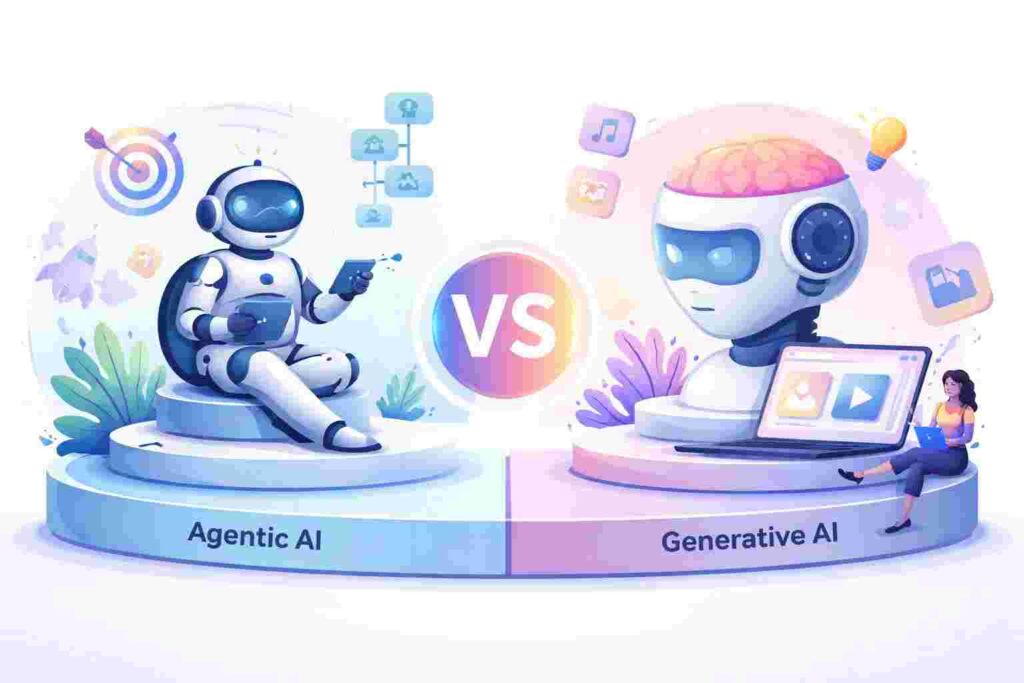
Agentic AI refers to AI systems that possess the capability to perform tasks and make decisions autonomously, acting on behalf of users or organizations. These systems utilize data-driven algorithms to analyze situations, weigh potential outcomes, and execute actions without continuous human intervention. Agentic AI frameworks are often embedded in robotics and automated systems across various sectors.
Definition of Generative AI
In contrast, Generative AI focuses predominantly on content creation. Leveraging techniques such as neural networks, Generative AI synthesizes new data based on existing datasets. It can create text, images, music, and even videos that are indistinguishable from human-generated content, finding applications in creative sectors like advertising and entertainment.
Key features of both AI types
- Agentic AI: Autonomy, decision-making capabilities, task-oriented functionalities, adaptability to environments, continuous learning.
- Generative AI: Content creation, pattern recognition, training on vast datasets, variability in outputs, creativity in solving problems.
Technical Mechanisms Behind Agentic AI vs Generative AI
In exploring the technical mechanisms behind Agentic and Generative AI, we uncover the diverse technologies and algorithms that empower these cutting-edge systems.
Machine learning techniques
Both AI categories rely heavily on machine learning. Agentic AI typically uses supervised learning algorithms that assess historical data to make real-time decisions, while Generative AI often employs unsupervised learning to identify patterns and create new outcomes without explicit directives.
Neural networks and architectures
Neural networks are at the heart of both Agentic and Generative AI. Agentic AI frequently uses deep reinforcement learning, which allows systems to learn from their actions and optimize their performance through trial and error. On the other hand, Generative AI utilizes architectures like Generative Adversarial Networks (GANs) and Variational Autoencoders (VAEs) to produce realistic data outputs through competitive learning processes.
Natural language processing in Generative AI
Natural language processing (NLP) underpins the functionality of Generative AI when it comes to text-based outputs. This involves analyzing, understanding, and generating human language in a way that is coherent and contextually relevant. Various models, including transformers, play a crucial role in enabling generative capabilities that range from producing short prompts to writing entire articles.
Business Applications of Agentic AI vs Generative AI
Venturing into business applications, both AI types offer innovative solutions across numerous industries, serving practical needs and enhancing efficiency.
Healthcare innovations
- Agentic AI aids in real-time patient monitoring, utilizing predictive analytics for early detection of illnesses.
- Generative AI enhances drug discovery by simulating molecular combinations to predict effective formulations.
- Telemedicine platforms leverage AI for automated patient inquiries and scheduling.
- Personalized treatment plans can be formulated based on extensive patient data analysis.
Financial services optimization
- Agentic AI automates trade execution in stock markets, minimizing human error.
- Generative AI improves risk assessment models by generating scenarios based on historical data.
- Customer service chatbots utilize both AI types to enhance client interactions, offering personalized advice.
- Fraud detection systems employ Agentic AI to identify anomalies in transaction patterns.
Marketing and customer experience
- Generative AI creates compelling ad copy and personalized email marketing campaigns to boost engagement.
- Agentic AI uses behavioral data to tailor marketing strategies for target demographics.
- Recommendation engines leverage both AI types to suggest products based on user preferences and purchase history.
- Predictive analytics in customer experience management anticipates customer needs, enhancing satisfaction.
Manufacturing enhancements
- Agentic AI coordinates supply chain management, ensuring timely delivery and minimizing costs.
- Maintenance predictions in industrial settings utilize data from machinery to forecast potential failures.
- Generative AI designs product prototypes, leading to shorter development cycles.
- Quality control processes are enhanced through real-time monitoring powered by Agentic AI.
Strategic Advantages of Agentic AI vs Generative AI
When analyzing the strategic advantages of Agentic versus Generative AI, we see that each offers unique benefits that can provide companies with competitive edges.
Decision-making capabilities
Agentic AI excels at decision-making in high-stakes environments, utilizing data analysis and predictive algorithms to evaluate risks and outcomes. This makes it particularly effective in industries like finance and healthcare, where timely decisions can have outsized impacts. In contrast, Generative AI can enhance decision-making by providing diverse scenarios and creative options for consideration, empowering teams to think outside the box.
Automation and efficiency gains
Both AI types drive automation, but their approaches differ. Agentic AI automates repetitive tasks, freeing human resources to focus on strategic initiatives. Generative AI boosts efficiency by rapidly producing content and insights from data, which can expedite workflows and enhance productivity across teams.
Innovation potential
With its capacity for creative outputs, Generative AI holds significant innovation potential. It fosters creativity in design, marketing, and product development, leading to unique market offerings. Meanwhile, Agentic AI’s ability to analyze data and optimize processes can lead to innovative operational strategies, transforming traditional practices into cutting-edge methodologies.
Limitations and Risks of Agentic AI vs Generative AI
Despite their advantages, both Agentic and Generative AI present notable limitations and risks that must be addressed for successful implementation.
Ethical concerns
One of the most pressing ethical concerns surrounding AI technologies involves bias in decision-making. Agentic AI, when fed biased data, can perpetuate or even exacerbate existing inequalities, particularly in sensitive areas like hiring and criminal justice. Generative AI, likewise, raises ethical questions related to authorship, copyright, and the potential for misinformation generation.
Data privacy issues
Both AI types rely on vast amounts of data, which raises critical data privacy issues. Organizations must ensure compliance with regulations like GDPR to protect user information. Insufficient data protection measures can lead to data breaches, significantly harming brand reputation and customer trust.
Accuracy and reliability challenges
While AI systems can process large datasets, they are not infallible. Agentic AI may struggle with unpredictable environments or scenarios it has not been explicitly trained on. Generative AI can produce outputs that, while plausible, may contain inaccuracies or factual errors, necessitating human oversight and verification.
Comparative Evaluation: Agentic AI vs Generative AI
To aid in understanding the differences more clearly, we provide a comparison table summarizing critical features of Agentic and Generative AI.
| Feature | Agentic AI | Generative AI |
|---|---|---|
| Primary Function | Autonomous decision-making and actions | Content generation and creativity |
| Data Handling | Historical and real-time data processing | Training on existing datasets to create new outputs |
| Applications | Healthcare, finance, manufacturing | Marketing, advertising, creativity |
| Ethical Concerns | Bias, decision-making transparency | Copyright, misinformation |
| Learning Approach | Supervised and reinforcement learning | Unsupervised learning |
Statistics and Market Trends in Agentic AI vs Generative AI
The landscape of AI is continuously evolving, with current market data highlighting significant trends and growth potential across both Agentic and Generative AI.
Growth statistics
- The global Artificial Intelligence market size was valued at approximately $136.55 billion in 2022 and is projected to grow at a CAGR of 38.1% from 2023 to 2030.
- Generative AI investments are expected to surpass $20 billion by 2025, reflecting a growing interest in its applications.
- Agentic AI technologies are estimated to contribute over $22.6 billion in cost savings across industries.
- According to Deloitte, 77% of organizations are expected to adopt AI by 2025, marking a significant increase from just 41% in 2021.
Investment trends in AI
Investment in AI startups has surged dramatically, with Venture Capital funding exceeding $70 billion in 2022, signifying robust interest in advancing AI technologies. Additionally, the trend of AI integration into business workflows is not only limited to tech giants; small and medium enterprises are increasingly adopting AI solutions, enhancing competitiveness.
Market adoption rates
An Accenture report indicates that companies utilizing AI could boost their productivity rates by up to 40%. This changing dynamic is leading to rapid market adoption, with sectors like retail and healthcare front and center in leveraging both Agentic and Generative AI for transformation.
Real-World Case Studies of Agentic AI vs Generative AI
Real-world case studies provide valuable insights into the tangible benefits of AI implementations. The following showcases measurable outcomes achieved through both Agentic and Generative AI technologies.
Case study 1: Healthcare
A leading healthcare provider implemented an Agentic AI system for patient monitoring and data analysis. Before AI adoption, the average patient wait time was two hours. Post-implementation, the average wait time was reduced to 30 minutes, significantly improving patient satisfaction and resource allocation.
Case study 2: Financial services
In the financial sector, a bank utilized Generative AI to enhance its customer service chatbot functionalities. Initially, the chatbot could handle 30% of customer inquiries automatically. After integrating advanced Generative AI capabilities, this figure rose to 70%, reducing operational costs by 25% and improving client satisfaction.
Case study 3: Marketing campaigns
A prominent marketing agency turned to Generative AI for content generation in ad campaigns. Initially spending 40 hours per campaign on content creation, they achieved a 300% efficiency increase, reducing creation time to just 12 hours and maximizing return on investment through tailored content strategies.
Future Outlook for Agentic and Generative AI Technologies
The future landscape of both Agentic and Generative AI is poised for groundbreaking advancements. As companies increasingly adopt these technologies, we can expect several trends to shape their evolution.
Predictions for adoption
Analysts predict that by 2030, the Agentic AI market will represent a significant share of the overall AI market. Industries will increasingly rely on autonomous systems to enhance efficiency and decision-making capabilities.
Technological advancements
We can anticipate advancements in neural architectures that could lead to faster and more accurate content generation in Generative AI. Additionally, Agentic AI systems will evolve to incorporate feedback loops, enabling them to learn from their actions continuously.
Potential regulatory impacts
As AI technologies advance, regulatory scrutiny will likely increase. Governments may impose stricter regulations concerning data usage, privacy, and ethical considerations, compelling organizations to adapt their AI strategies to comply with evolving guidelines.
FAQs About Agentic AI and Generative AI
What is the difference between Agentic AI and Generative AI?
The primary difference lies in their functions. Agentic AI focuses on autonomous decision-making, taking actionable steps based on real-time data, while Generative AI specializes in creating new content or outputs based on existing information. As a result, they serve different purposes but can complement each other in applications.
How do businesses benefit from these AI types?
Businesses leverage Agentic AI for enhancing operational efficiency and improving decision-making processes, while Generative AI boosts creativity and enables content generation. The combination of both can lead to increased productivity, reduced costs, and innovation across various sectors.
What are the ethical considerations?
Both AI types raise ethical issues, including potential biases in algorithms, data privacy violations, and concerns regarding authorship and misinformation. Addressing these challenges involves establishing robust guidelines and frameworks, ensuring that AI technologies are used responsibly.
Can Agentic AI generate content?
Agentic AI primarily focuses on decision-making and automation. However, it can perform content generation tasks if integrated with Generative AI capabilities. This combination allows organizations to benefit from both leveraging decision-making while also producing tailored content as needed.
What are the key challenges in implementing these technologies?
Challenges in implementing Agentic and Generative AI include data privacy concerns, managing ethical implications, ensuring system accuracy and reliability, and securing stakeholder buy-in. Organizations must navigate these hurdles strategically to realize the full potential of AI technologies.
What industries are most impacted by these AIs?
Industries such as healthcare, finance, marketing, and manufacturing are significantly impacted by both Agentic and Generative AI technologies. These sectors utilize AI to drive efficiencies, improve service delivery, foster creativity, and gain competitive advantages in the marketplace.
Conclusion: The Future Landscape of AI Technologies
In summation, the Agentic AI vs Generative AI discussion is not merely academic; it holds practical relevance for businesses and consumers alike. By comprehensively understanding the differences, applications, and implications of these AI types, organizations can strategically deploy them to harness their respective benefits. As AI technologies continue to evolve, their integration will shape the future landscape of countless industries, driving efficiencies and innovation in ways we are only beginning to comprehend.